







Book Review
BOOK REVIEW: SIR WILLIAM LYONS ON JAGUAR – The Legend Explained in His Own Words

BOOK REVIEW: SIR WILLIAM LYONS ON JAGUAR
The Legend Explained in His Own Words
HEAVEN ON EARTH
Few figures in the auto industry are as singular as Sir William Lyons. There is – as you’d guess – the usual suspects: Henry Ford, Walter Chrysler and those rowdy Dodge Brothers in the States, along with Bugatti, Chapman, Ferrari and Porsche from Europe. Having not affixed his own name to his car company, William Lyons lacks the notoriety – until, of course, you reflect on the lineup of singular designs for which he’s responsible.
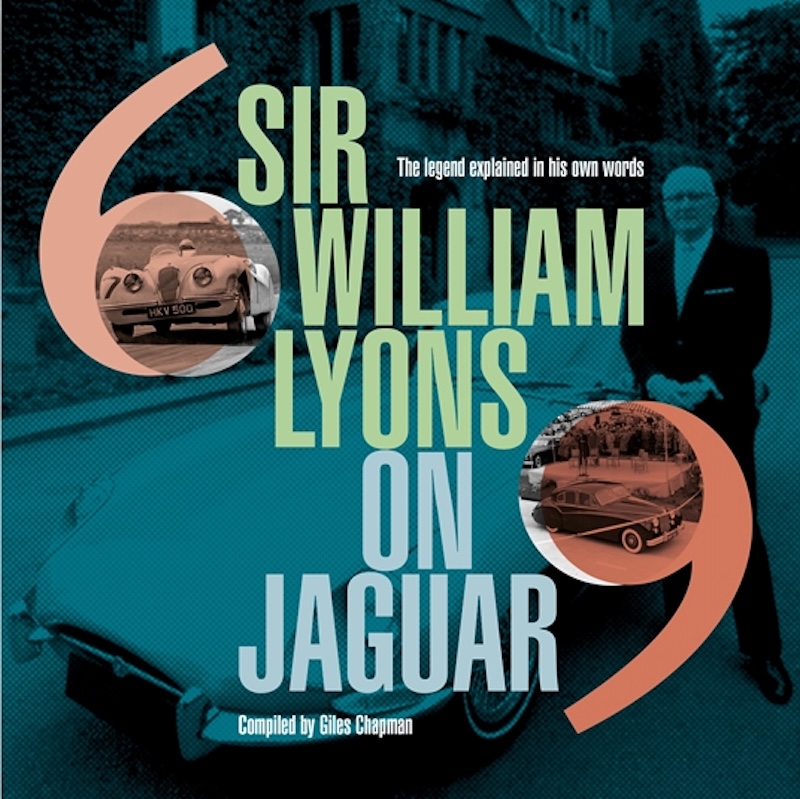
That lineup is amazing, and becomes even more so when you consider the period in which it was constructed – and the (relative) value it provided. The tale is told in SIR WILLIAM LYONS ON JAGUAR – The Legend Explained in His Own Words, compiled by Giles Chapman and published by Evro Publishing.
Coincidental to the book’s arrival on my doorstep was a Jaguar update: Gerry McGovern, head of design for Jaguar Land Rover (now JLR), was released from his responsibilities on that same day; Irony is often difficult to define, but in my small world that confluence was ironic. Jaguar is in the midst of an EV-driven rebrand (one that not everyone is delighted with), and as the exec most heavily involved in the brand’s redirection, speculation suggests that the controversy contributed to McGovern’s demise. Regardless, after a century of what began as Swallow Sidecars, the Jaguar story remains compelling, even if its future is increasingly cloudy.
The book is taken from remarks made by Sir William Lyons to the Institute of the Motor Industry in 1969. As you’d hope, Lyons begins at the beginning in 1922 and the formation of Swallow Sidecars, which built – as you’d guess – sidecars. In the absence of the Model T Britain didn’t mobilize with the speed with which America mobilized; many families used public transportation, and if they had a motorized ‘anything’ it was often a motorcycle. Attach a sidecar and you could take the family, and as an ‘aside’, in England’s frequently wet weather you might avoid falling over. While the sidecar was far more than just a side gig, the company quickly went into the custom body business and, from that, its own car manufacture. And that enterprise begat Jaguar.
In these published remarks, Lyons gives us – as he did the Institute’s attendees – Jaguar’s history from roughly 10,000 feet. There’s little that is granular, and almost as much about the acquisition of truck and bus businesses as there is the E-Type. But the development of the XK engine gets appropriate space, as does the debut of the XK 120, the company’s racing successes at Le Mans and the development of Jaguar’s global footprint.
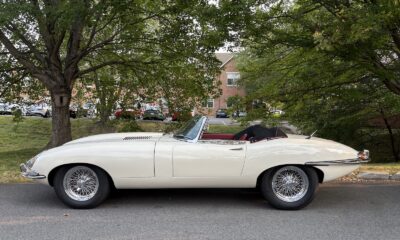
Beyond the compelling narrative is Lyons voice; you’re hearing it from ‘the man’. And if you enjoy the story you’ll love the pics, which accurately depict the Jaguar’s sensuous offerings and, in the advertising photos, the of-the-moment models used to augment the sensual shapes. (If you buy the book, please turn to pages 32 and 33, where color photography of the E-Type debut deserves a place in your bedroom…at the assisted living center.)
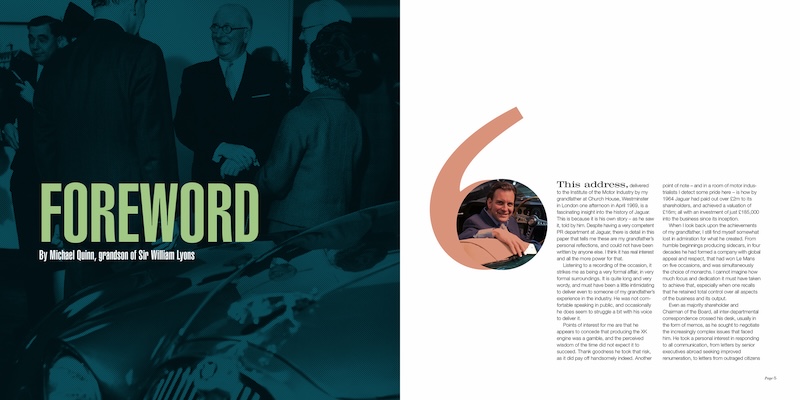
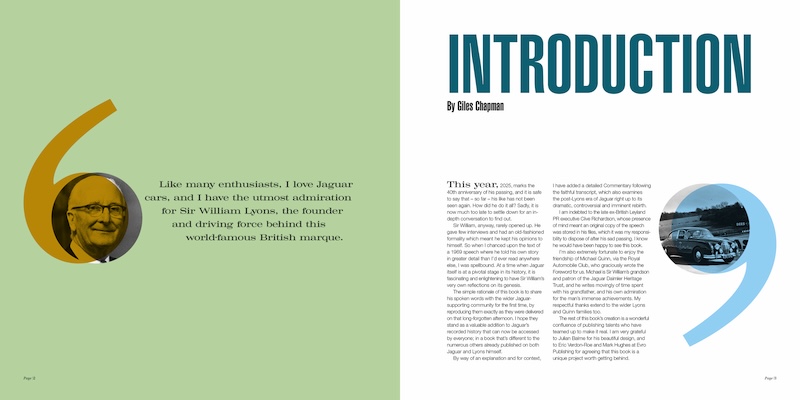
Also of note: The book benefits from a foreword written by Sir William Lyons grandson, Michael Quinn. And Giles Chapman supplies an epilog, looking at Sir William Lyons’ legacy from Chapman’s editorial perch in 2025.
If you own a Jaguar you need this on your shelf or coffee table. And as a Jaguar enthusiast, after its brief reading I’d enjoy becoming an owner.
SIR WILLIAM LYONS ON JAGUAR is distributed in North America by Quarto Publishing USA, and can be ordered via Quarto’s website: www.quartoknows.com. It retails for $70 in the U.S, $100 in Canada. The writer’s review copy (I’m keeping it!) was provided by Evro.