







Car Reviews
The 2026 Infiniti QX60: A Refined Machine for a Vanishing Era

The 2026 Infiniti QX60:
A Refined Machine for a Vanishing Era
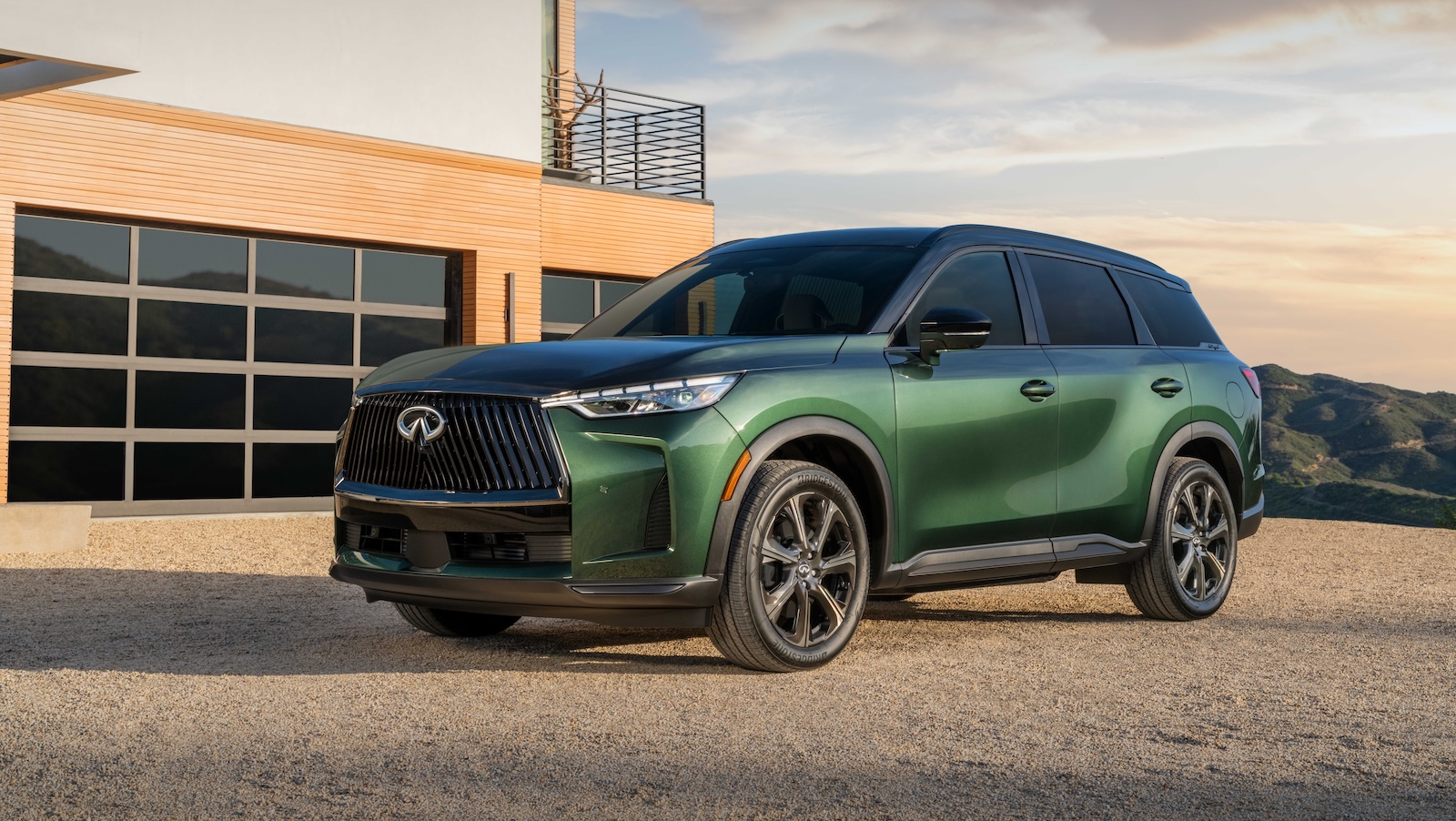
The 2026 Infiniti QX60 arrives at a moment of profound industrial divergence. On the surface, this three-row luxury SUV fulfills the standard executive brief: a polished cabin, family-friendly utility, and a price tag that scales from $52,000 to nearly $70,000. Yet beneath the sheet metal lies a deeper tension – one that says less about a single vehicle than it does about the precarious state of American manufacturing.
The Complexity Trap
The internal combustion engine is a marvel of engineering. Still, it is also the refinement of an 18th-century concept, born of and limited by classic physics: creating a massive explosion and harnessing a fraction of its power for work.
A modern turbocharged engine holds upwards of 2,000 moving parts. On its best day, it converts roughly 30 percent of gasoline’s energy into forward motion; the rest is surrendered to heat, vibration, noise, and pollutants.
By contrast, an electric motor uses about 200 parts and achieves 90 percent efficiency. The loss is heat only.
The sitting U.S. president tilts at EVs, but in both war and industry, the advantage invariably shifts to the most efficient producer. It was true in 1945, when economic might crushed militarism. It is true now as China and India move nearly a decade ahead in battery chemistry and manufacturing scale. Over the past 12 months, Trump and Congress derailed a massive effort to catch up.
While the global market pivots, American automakers continue to pour vast intellectual capital into squeezing incremental gains from a machine that has already reached its ceiling, while being increasingly pressured to look backwards by the politicians in power.


Moonshot on an Old Foundation
For 2026, Infiniti replaced its smooth V-6 with a 2.0-liter variable-compression turbocharged (VC-Turbo) four-cylinder. It is a technological moonshot – watchmaking at 6,000 rpm. Through a complex multi-link mechanism, the engine physically alters its piston stroke in real-time to prioritize either efficiency or power.
But complexity has a tax. On the road, the VC-Turbo feels overextended; turbo lag is palpable, and the engine often sounds strained.
More damning is the reliability record: the engine is the centerpiece of a sweeping recall affecting 450,000 vehicles.
While official statements cite bearing wear, technical filings point to failures in the A-, C-, and L-link pivot bearings – the very heart of the variable-compression system. When these linkages fail, they shed metal into the oiling system, leading to catastrophic failure. The vulnerability is not a peripheral flaw; it is the design itself.
Nissan’s stubborn clinging to this technology while eschewing hybrid development is the single most significant factor in the company’s declining market share. Neglecting product development, Carlos Ghosn’s real crime, was the second most. In the meantime, Toyota hybridized and now has a slice of the North American pie double that of Nissan’s and nearly rivaling GM’s.
New cars and trucks come in four basic flavors. Understanding the difference matters.
Efficiency briefly
Internal-combustion engine (ICE)
- Moving parts: ~2,000
- Energy to motion: ~30%
- Real-world mpg: 20–25
- Maintenance: high
- Trend: rising complexity, shrinking returns
Hybrid electric vehicle (HEV)
- Architecture: engine + electric motor
- Effective moving-parts load: far lower than ICE
- Why: motor handles low-speed, high-load work; engine runs in its sweet spot
- Real-world mpg: 40–50
- Reliability: dominates every major Top-10 list
- Trend: mature, proven, low-stress technology
Plug-in hybrid (PHEV)
- Electric range: 30–50 miles
- Daily gasoline use: often zero
- Real-world MPG-equivalent: 70–100+
- Maintenance: low
- Trend: meaningful bridge technology allowing drivers to experience quiet, smooth electric power
Battery electric vehicle (BEV)
- Moving parts: ~200
- Energy to motion: 90%+
- Real-world efficiency: unmatched
- Maintenance: lowest of all. Batteries and motors literally last millions of miles, according to recent research.
- Trend: China now leads in innovation, battery production, and has mastered cost-saving manufacturing techniques unseen in American factories. Rapidly expanding technology parallels the growth in quantum physics.
Every central region — China, Europe, India, South America, and the rest of the world — is accelerating its EV transition. North America is the only region where EV penetration is not keeping pace with global growth.
Competitive Gap
In a segment where electrification is now the baseline, the QX60’s sub-21-mpg performance is an anachronism.
- The Hybrid Standard: Lexus RX hybrids deliver nearly 40 mpg with seamless transitions.
- The Plug-In Reality: BMW and Volvo offer plug-in hybrids that handle the average daily commute without burning a drop of fuel.
- The Reliability Shift: The industry’s most reliable vehicles are no longer ICE holdouts, but hybrids from Toyota and Honda that pair electric motors with simple, lightly stressed engines.
Inside, the QX60 is beyond reproach. The materials are rich, the “Google Built-In” interface is intuitive, and the one-touch second-row access is a masterclass in ergonomics. It is a lovely place to sit while the world moves on.


New North American Reality
The geopolitical insulation that once protected Detroit is evaporating. Tesla is no longer the world’s leading EV maker; that title belongs to China, whose manufacturers have achieved a decade’s lead in cost structure and battery tech.
Consumers can already purchase sophisticated Chinese EVs built in Mexico that are a third less expensive than their American counterparts, and a Canadian-built wave is close behind.
Meanwhile, federal policy continues to offer the Big Three just enough rope to hang themselves – easing pressure to innovate while encouraging a double-down on technologies that cannot win the long game.
Just last week, President Trump signaled a stark pivot, saying he would “welcome” a Chinese EV factory in the United States so long as it hired American workers. If that happens, the President could stop by for the ribbon-cutting on his way to watching the demolition of the Chrysler Tower.
The Bottom Line
The 2026 Infiniti QX60 is a comfortable, well-appointed SUV. But as an industrial symbol it is a sobering story. The VC-Turbo is not a bad engine; it is an elegant answer to a shrinking question. For the forward-looking buyer, the QX60 is less a bridge to the future than a beautifully upholstered cul-de-sac.