




Book Review
BOOK REVIEW: THE COMPLETE BOOK OF JAGUAR – FOR YOUR EYES ONLY

BOOK REVIEW: THE COMPLETE BOOK OF JAGUAR
FOR YOUR EYES ONLY
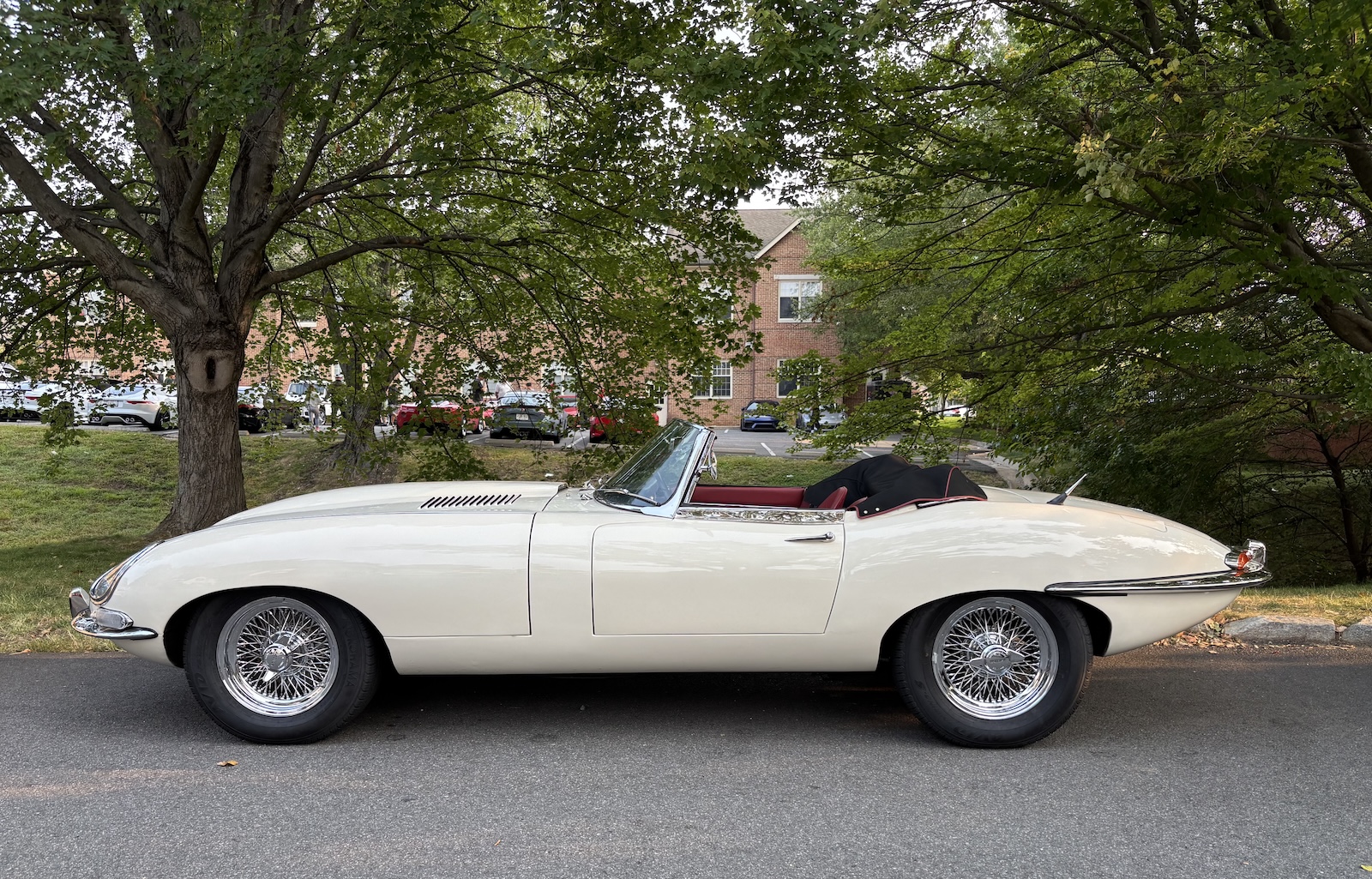
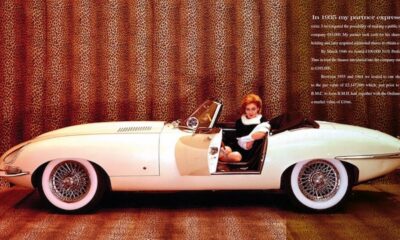
You weren’t there. And with that, you simply don’t know. In the early ‘60s, outside an import showroom in San Antonio, I saw for the first time the Jaguar E-Type. In white, it was inside and I was outside, but it popped through the showroom glass, into both my head and heart. In those 60+ years since getting acquainted, there have been any number of show cars, concepts and exotics capturing my gaze, but none has grabbed my attention like that E-Type…and time, as you’d guess, is running out.
For those not in San Antonio, author Nigel Thorley provides a relatively concise 272-page overview of Jaguar and its history in his second edition of THE COMPLETE BOOK OF JAGUAR, recently released by Motorbooks and made available here in these United States. And while some may believe Jaguar began with the E-Type, the Jaguar name begins in the mid-‘30s, while the company’s roots date to the mid-‘20s. In short, the concept of swift, stylish motoring at Jaguar is now in its second century. With recent developments at the HQ of Jaguar Land Rover, however, what form the next century takes is anyone’s guess.

While pondering that, Mr. Thorley’s work provides – in one volume – a brilliant historical overview. Jaguar’s founding father is William Lyons, whose take on Jaguar – SIR WILLIAM LYONS ON JAGUAR – I reviewed for this site in December. What we know as Jaguar began in 1926 as the Swallow Sidecar and Coachbuilding Company, and that endeavor’s sporting tradition could be traced to the SS1, introduced in 1931. In the midst of a worldwide depression affordability was top of mind, and it was with the SS1 that what became Jaguar would establish its business model: A significant amount of style, available at an attainable price point. And until very recently that has remained the model.
That sporting identify was solidified with the introduction of the open SS Jaguar 100. With the cockpit sitting well back on the chassis, and that chassis propelled by 2.5 liters of Jaguar-specific six, the ‘100’ suggested a top speed of the ton, although reality may have fallen a bit short. From a design standpoint, however, it was a moon landing. And while all Jaguar production was curtailed by the onset of World War II, the company had established a template for postwar specification.
In those immediate postwar years, Jaguar – like most of Great Britain – was focused as much on digging out as moving on. But the company’s debut of its XK120 in 1948 (the ‘XK’ referred to the roadster’s all-new six cylinder powertrain, while ‘120’ was its claimed top speed) was just what motoring enthusiasts needed as they recalibrated from the prewar reality. The Marshall Plan would rebuild Germany, but it wouldn’t happen in 1948. And while Enzo Ferrari would begin construction of his own sports car that same year, production numbers were small, and its marketing was essentially word-of-mouth. In Italian. Jaguar’s XK120 had the well-heeled car enthusiast almost to itself.
Although Mr. Thorley doesn’t devote a lot of space to Jaguar’s success in competition, the company’s domination of Le Mans with the XK120-derived C-Type and later D-Type are chronicled; the company’s competitive success would inform its lineup in the following decades. The first example of that was, of course, the aforementioned E-Type. And not only did the design explode the British variant of ‘hub bub’, under its exotic skin was an equally exotic platform. What Thorley describes as an ‘extremely complex and well-executed monocoque’ is shown, and if you can’t acquire a restored E-Type, you should look for its restored monocoque.
At its launch the E-Type delivered 265 horsepower from its 3.8 liter DOHC six, propelling the 2-seater to 150 miles per hour. Available in both convertible and coupe form, neither looks to be a modification of the other; both exhibit a purity of line without compromise. And both took the motoring world by storm. Enzo Ferrari, with both Bertone and Pininfarina in his back pocket, described the E-Type as the most beautiful car ever made – and who am I to argue with Enzo?
There is, of course, much more to Jaguar after the E-Type. Sedans are a large part of the company’s story, and the XJ6 served as the prototype for a significant part of Jag production in the ‘70s and ‘80s. And while its 4-door profile shares absolutely nothing with the E-Type, the XJ was very much a product of William Lyons’ vision, with a visual athleticism typically not part of a sedan’s descriptive. In all of its forms some 400,000 XJs were built before the company moved on to the XJ40.
Later we’d have the X-Type, an exploration of the entry-level market. And the S-Type would serve as a midsize replacement for the XJ, again sitting back on its chassis, with a choice of V6 or V8 powertrains. Much later Jaguar would tip-toe into the SUV space with its F-Pace, while the F-Type raced through the 2-seater, E-Type space.
Beyond the development of the cars is the corporate to-and-fro, with mergers and buyouts. Jaguar Land Rover is now owned by Tata, the Indian conglomerate. And with that group’s rush to build EVs the internal combustion plans are – at best – muted. But then, we’ll always have the memories – helped in no small part by Nigel Thorley’s book.
THE COMPLETE BOOK OF JAGUAR; EVERY MODEL SINCE 1935 is published by Motorbooks, and will be available in early February. It contains 272 pages, and is $60 in the U.S. To order, more information is available at Quarto.com.