


Car Reviews
Hyundai’s Santa Cruz All-Wheel Drive – ADDING FUN TO FUNCTIONALITY

Hyundai’s Santa Cruz All-Wheel Drive
ADDING FUN TO FUNCTIONALITY
Sunrise. Sunset. Industry publication Automotive News reports that Hyundai’s Tucson-based Santa Cruz won’t enjoy a second act after its initial run ends around 2027. Introduced at virtually the same moment as Ford’s compact, car-based Maverick, the Santa Cruz offers the same number of doors, a front-wheel drive/all-wheel drive unibody platform and a pickup bed. But the Santa Cruz omits the hybrid, and its bed is aggressively abbreviated; you may sit in its 4-foot bed, but you sure-as-hell won’t stretch out in the bed. And while it starts below $30K, the one to buy – like our test vehicle – sits firmly in the low-to-mid $40s.
For you to embrace the Santa Cruz, you first have to reconfigure your perception of a truck. For many that perception is fueled by the F-150, Ram 1500 or Chevy’s Silverado. And while the compact pickup category was at one time full of entries (hell, even Mazda offered one – rotary-powered!), today it’s just the aforementioned Maverick and Santa Cruz, and both are based on compact crossover platforms. If you want to upsize Honda continues to offer its Ridgeline, which includes four doors and an abbreviated bed atop the Pilot/Odyssey mechanical packaging.
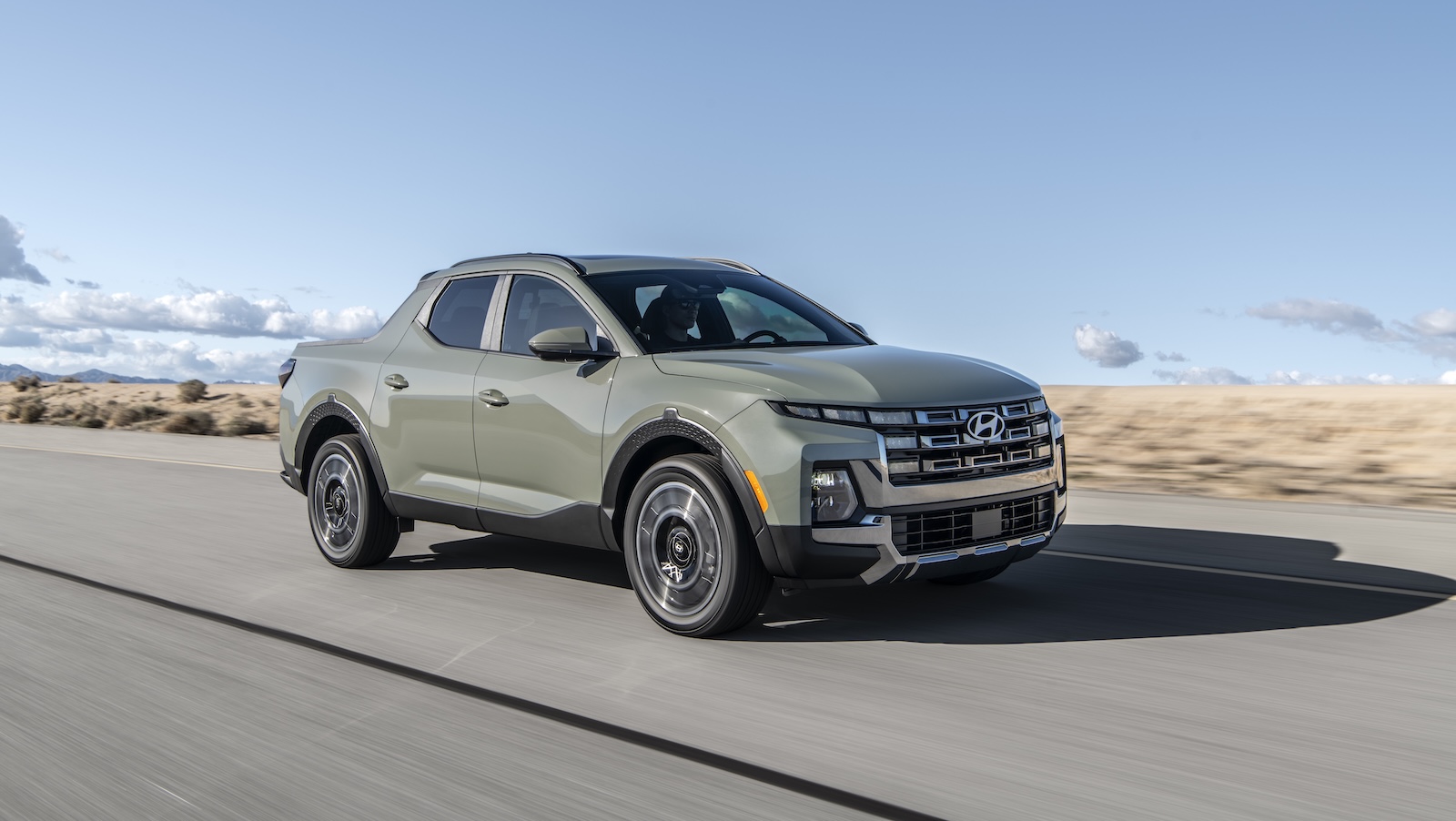
With all that, there’s a lot to like in Hyundai’s Santa Cruz, beginning with its fun-to-look-at looks. While the Tucson crossover, on which its based, is a relatively benign design exercise, the Santa Cruz offers real visual spunk. And its footprint is longer than the Tucson’s; the Santa Cruz’s wheelbase is 118 inches, a full ten inches longer, while its overall length – at almost 196 inches – is over a foot longer. That footprint allows for easy access to the backseat and that four feet of bed.


Given that we’re 25 years into a new century, Hyundai’s product team has adorned its Santa Cruz with the obligatory cladding, but the rubber framing the wheel openings is nicely integrated (they haven’t gone all ‘Subaru’), and in the Hampton Gray (really…) exterior the end result is a visual that’s almost integrated. In short, I like it. If the Maverick has one shortcoming, it’s the lack of visual excitement.
Once inside, the black leather seating in our Limited test vehicle could use some highlights, but is accommodating, supportive and – when heading to the boonies – looks like it’ll clean up. The driver is greeted by both info and infotainment, which provide roughly two feet of screen spanning just over one-half of the dash. Thankfully, HVAC and audio remain beneath the screen, and can easily be tuned – or fine tuned – for your needs of the moment. The transmission lever is conventional, cup holders are right there, and the charging platform for the iPhone located the phone where you can see most of it, and the charging location isn’t someone’s idea of a mystery tour.


Under the hood of the Santa Cruz, Hyundai supplies two choices. The base, normally aspirated 2.5 liter four will cover the miles, while the available 2.5 liter turbo four will deliver the smiles. Our Limited trim offers only the turbo and only all-wheel drive. In Car and Driver testing, the 281 horsepower turbo four will get you from 0-60 in about six seconds, while delivering an EPA estimated 18 City/25 Highway/20 Combined. (Car and Driver achieved 30 miles per gallon on the magazine’s 75-mile highway loop.)
The base 2.5 liter – with 181 hp – will certainly get you where you need to go, and the $5K price premium for the turbo can seem excessive. But if you have the wherewithal to check the turbo box, I’d check it.
With final assembly in Montgomery, Alabama, the Santa Cruz isn’t completely tariff-proof, but it’s better positioned than something coming from South Korea. Built alongside the Tucson, its production line might not allow for many variables, but here’s one Hyundai should consider: Build an extended cab version with at least 5’ of bed, which would improve the utility while recognizing that not every hauler needs to be a family hauler. And at the same time, cut the turbo price bump in half (to around $2500) or, even better, make the Tucson’s hybrid drivetrain standard on all trims. Finally, keep the Santa Cruz in production long enough for a redesign.
Back in the day we had both Chevy’s El Camino and Ford’s Ranchero. Those aren’t coming back. And in their absence the Santa Cruz should stick around.