



Car Reviews
JEEP’S GRAND CHEROKEE L – From Mainstream to Airstream

JEEP’S GRAND CHEROKEE L
From Mainstream to Airstream
From the editor: Jeep parent Stellantis has been ‘in the news’ of late, on both the product and financial pages. From a product standpoint, the plug-in hybrid Jeep is dead (way dead), while an all-new Jeep Cherokee Hybrid is arriving in showrooms as this is written. And while the ’26 Grand Cherokee receives a refresh, the ’25 models (both 2-row and 3-row) are enjoying significant discounts, making Jeeps once regarded as overpriced suddenly very good deals. We’ve recently taken advantage of those deals, buying a ’25 Grand Cherokee Limited for less than we would have spent on Subaru’s new Outback. That, to be sure, is an apples vs. oranges comparison, but then, if you regularly carry a lot of apples you’ll be well served by the Jeep when it’s built as a 3-row Grand Cherokee L! In the hyperlink is an offer representative of what’s currently available.
My wife and I have been a small part of the Jeep family since 1987, beginning with a bright red Jeep Cherokee 4-door with 2WD and a stick; at least we got the transmission right. In 1998 we were able to migrate to a new ’98 Grand Cherokee, a metallic green Laredo with the same inline six powering all four wheels through Jeep’s available automatic.
Eight years later that ’98 morphed into an ’06 Grand Cherokee Limited with Hemi V8 power. Its footprint, relative to the 1st-gen GC, is larger, and the Hemi – as you’d guess – is thirstier. But we’ve enjoyed its capability and refinement, and that’s why we still have it. In its 15+ years it’s yet to crack 120K miles, and has – in that time – given us relatively trouble-free service.
With that as context, you’ll understand my interest in an all-new Grand Cherokee, especially one which, in ‘L’ form, features 3-row seating for the first time in a Grand Cherokee – although not the first time in a Jeep. Built in combination with the 2-row GC, both benefit from an all-new platform, substantially upgraded interiors and elevated window stickers.
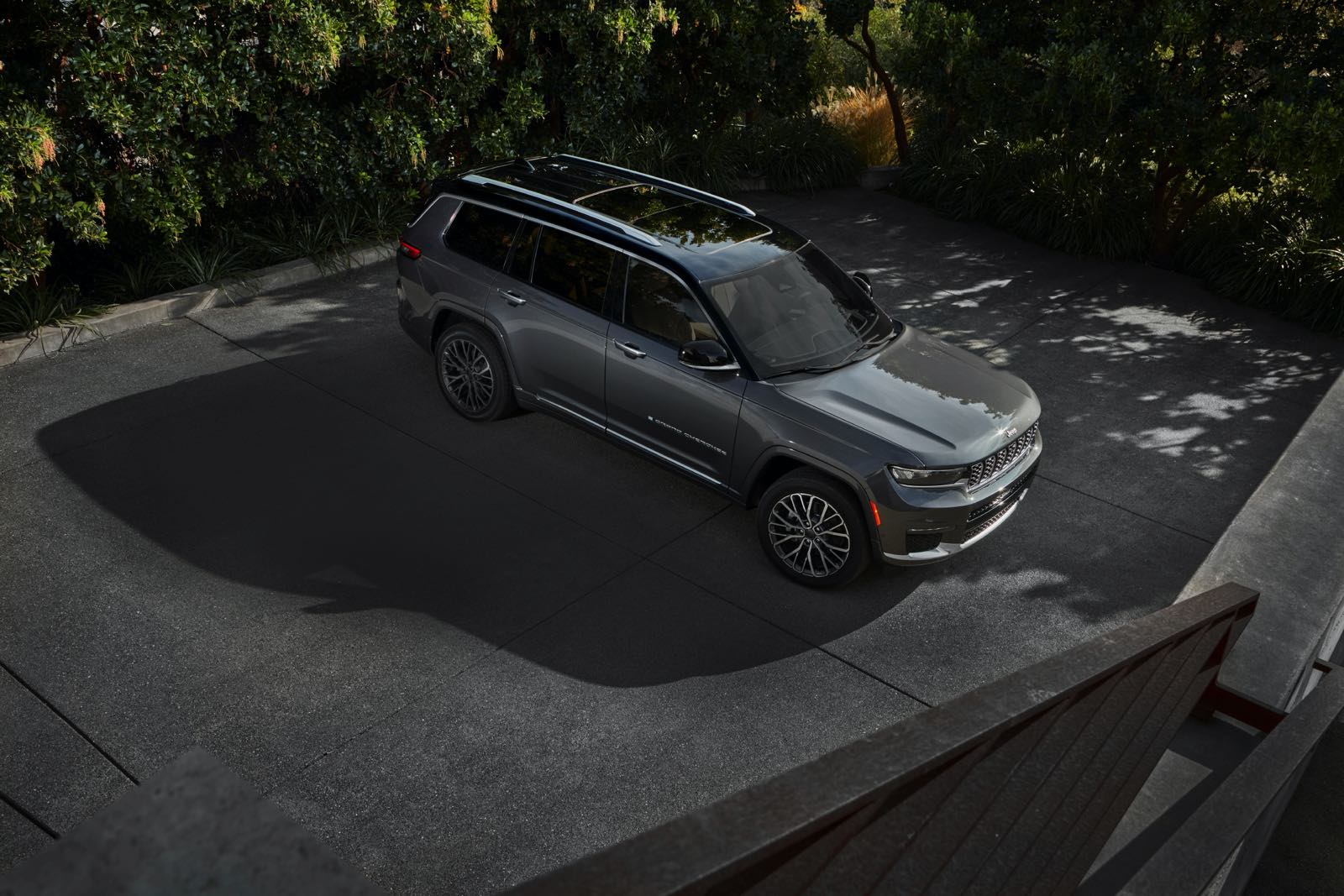
In the walk-up you’ll notice immediately the L’s extended length and wheelbase, but then, this is subjectively a more upscale design than was given the previous Grand Cherokee, built from 2011 through the 2022 model year. If 4WD variants of what is known as the WK2 Grand Cherokee were ‘trail rated’, the Grand Cherokee L is ‘mall rated’, given its 205 inches of overall length perched on 122 inches of wheelbase. Its length isn’t off-putting unless, of course, you’re parking in a downtown office building, where spaces are less-than-generous. If that’s the case, let the valet do his magic. And walk away.
Inside, our Summit trim generated the upscale vibe appropriate to the L’s $66K window sticker. After testing the over-$ix-figure Grand Wagoneer just a few weeks ago, the ‘value’ of the Grand Cherokee L surprised us. Obviously, almost $70K remains a lot of money for most households, but given the luxury, utility and all-road versatility, the Grand Cherokee L – even in its top-level trim – impresses as a good value.
Behind the wheel, outward visibility is good as the greenhouse is essentially unobstructed. In the Summit the perforated and quilted leather, in a tone Jeep calls ‘Tupelo’, was beautifully appointed, but the front seats were already showing signs of soiling. The wood trim provides a nice accent on the dash and doors, while the infotainment screen is restrained, and knobs – you know, the ones whose function you can immediately assimilate – remain.
In the driver’s seat, to your immediate right you’ll note Jeep’s Selec-Terrain switch, offering selectable terrain modes; it’s standard on 4X4 models in Limited trims and above. The five modes include Auto, Sport, Rock, Snow and Mud/Sand; in our week with the GC L we had no need for anything but Auto and Sport, but given that it was March anything could have happened – and the big Jeep capably prepares you for the ‘what if’.
The reason for a 3-row is, of course, the 3rd row. As an environment for two adults the rear bench is quite comfortable, although accessing it is easier if you’re eight than it is at 68. With the 3rd row down cargo capacity is almost 47 cubic feet, while with it up capacity falls to 17 cubic feet. Of course, that’s what roof -mounted storage is for, and if a family of six is traveling you’ll probably want it. I liked the additional length for just throwing a bike in and taking off. There, the bike is avoiding the elements, and bike thieves are avoiding the temptation.
Under the hood, Jeep’s 3.6 liter normally-aspirated V6 is standard, while Jeep offers the 5.7 liter Hemi V8 as an option on Overland and Summit trims with the 4X4 drivetrain. The V6’s 293 horsepower and 260 lb-ft of torque feel surprisingly robust in most day-to-day driving, although the Sport mode gives it slightly better engagement at – we’ll guess – a penalty in fuel economy. With the V6 towing is capped at 6,200 pounds, which is more than enough for the obligatory Airstream, if that Airstream is small. And with an EPA estimate of 18/25/21 you might survive the recently imposed embargo on Russian oil.
Opt for the V8, which – in my view – should be available across the Grand Cherokee L lineup, and you’ll have 357 horsepower and 390 lb-ft of torque to propel your 5,000+ pounds of vehicle and (of course!) stuff. You’ll also enjoy 7,200 pounds of towing capability, allowing for a bigger payload of wine in that obligatory Airstream. Of course, the V8 is thirstier, but not stupidly so; the EPA gives it a 14/22/17 estimate – just ask for a higher credit limit from Shell.
While our Summit was priced at almost $70K, you can get in for as little as $42K. If it was my money or monthlies, I’d spec a Limited with towing package – nothing else – and be all-in for about $48,000. Common sense would suggest the mid-level Limited trim come with the Hemi while – of course – Jeep parent Stellantis still builds a Hemi. Here’s hoping it will.