






Book Review
REVIEW: LEGENDS IN MOTION

REVIEW: LEGENDS IN MOTION
INSIDE STORIES AND DRIVING ADVENTURES
FROM THE WONDERFUL WORLD OF CARS
You need only find a Cars and Coffee to know the enduring appeal of the automobile, across all age groups and – increasingly – both genders. For those paying attention, this is nothing new. Author Gary Witzenburg has been paying attention longer than most, and in his role as an experienced automotive journalist he’s taken notes. In the recently released LEGENDS IN MOTION, Mr. Witzenburg generously shares those observations with anyone willing to buy his book.

As you’d hope, Gary begins at the beginning, giving ample credit to his father Lee for providing him with his love for cars and their design. As Gary was growing up in a Cleveland suburb, his dad benefited from a company car. While my earliest automotive memory is a ’54 Dodge, Gary enjoyed – via his dad – a ’51 Buick, ’54 and ’58 Cadillacs, a ’60 Thunderbird and a ’62 Pontiac Bonneville. All are notable, and all speak – in various ways – to what many regard as Detroit’s Golden Age.
Gary’s ‘auto’biography steps on the gas with the licensed teenager obtaining his own rides. And based on both the narrative and subsequent acquisitions, the kid liked driving. Out of the starting gate he has – in high school, forgawdsake – a ’57 MGA. With a chassis providing a real point-and-shoot capability, combined with a 4-cylinder powertrain that – in Detroit terms – fired only blanks, the MG was soon exchanged for a ’57 Corvette, which Gary customized. The Corvette provided the young Mr. Witzenburg almost everything he could ask for recreationally, but the limitations imposed by its 2-place seating (how do you invite a date into the back seat when there is no back seat?) led to a ’60 Chevy convertible.
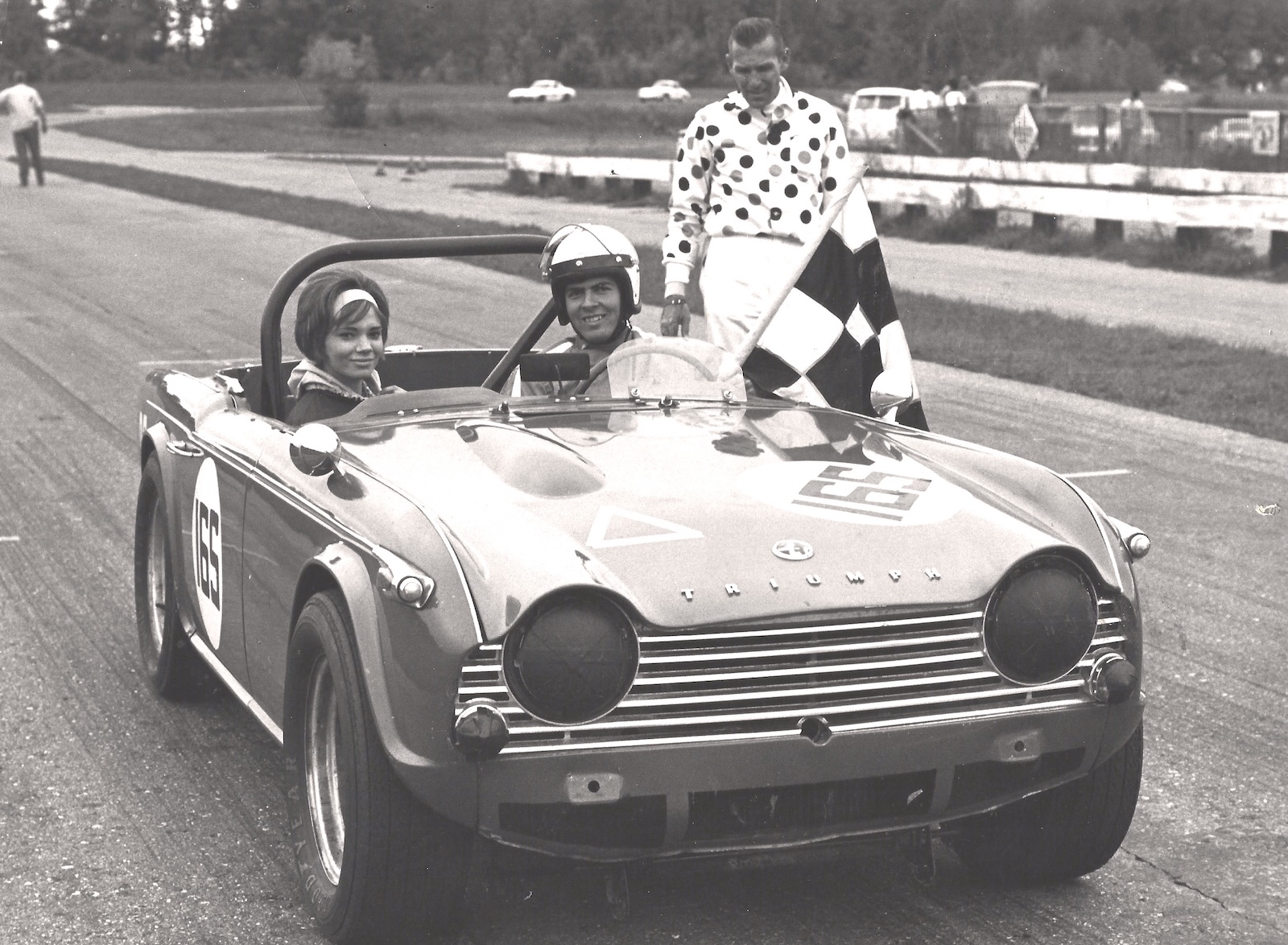
With plenty of style and generous power, the ’60 was big, drove old and – by that time – was mechanically fragile. Its lack of reliability led to a trade for a Chevy Nova convertible, and that normality begat a ‘66 Triumph TR4A, with delivery at Triumph’s British factory.
After a tour of legendary racing venues in Europe, Gary returned to the States and began his own racing at tracks in and around the Midwest. These initiatives were met with success – along with the knocks and bruises that you have when a car, a driver and the track are just getting to know each other.
Buying, customizing and racing was the foundation, the pursuit of an engineering degree provided the syllabus, and I’ll suspect Gary’s time in the Navy cemented his interest in travel; you know, ports unknown. Regardless of the impetus, Gary’s career took a journalistic turn when, after his start in GM Engineering was interrupted by three years of service in the Navy, he was offered the role of Engineering Editor for Competition Press (which later would become Autoweek). After Competition Press Gary would tackle freelance gigs for numerous national outlets, automotive PR for GM’s Buick Division, and – after some 15 years back at GM – would again embark on a successful freelance career. Much of that output is combined in the highly readable LEGENDS IN MOTION.
The book’s Table of Contents tells you most of what you’ll need to know about Gary’s automotive bandwidth. The first chapter takes us from Gary’s automotive beginnings to time spent with a Lotus Evora, an early DeLorean (there were few ‘later’ DeLoreans!) and a lap of America via Brock Yates’ Cannonball Express: One Lap of America, a nine-day tour of America – and its Interstates.
Chapter Two is – as its title suggests – From the Drawing Board, and begins, as it should, with GM’s head of design, Bill Mitchell, and the Stingray concept. If of a certain age – or hell, any age – Corvette’s represent a special place in an enthusiast’s head and heart. I can still remember my first Corvette sighting, and the assembly of an AMT Corvette model occupied a lot of time in the back of our ’63 Dodge wagon during an oh-so-hot (no a/c) summer vacation.
Although the Stingray’s birthing runs only two pages, it’s enough to supply an outline and, to its credit, have you looking for more. And within that same chapter, ‘more’ includes an overview of the GM EV1, Ford’s Mustang, GM’s Camaro and Pontiac’s Firebird. And while those are the biggest stories (and most accessible in supporting literature), Gary also details the beginnings of Cadillac’s Allante’, Chevrolet’s SSR and Pontiac’s Solstice. And if you have no memory of those models, buy the book!
The third chapter – Echoes of the Road – looks at both the iconic cars and those creators responsible for their design and/or construction. Elegance is the operative word here, but profiles of Carroll Shelby, Zora Arkus-Duntov and John DeLorean are what’s (for me) most compelling.
On the Grid is the umbrella for Gary’s fourth chapter, and takes you from his repurposed Datsun 510 4-door to time behind the wheel of a Greenwood-type Corvette to his wins at Nelson Ledges. Beyond Gary’s own racing, he gives us a great overview of Trans-Am (written for an Amelia Island Concours Program in 2008) when it was arguably America’s premier road-racing series. The names are there, the cars are there, and dialogs with drivers Parnelli Jones, George Follmer and Sam Posey are both enlightening and – as you’d hope – entertaining.
LEGENDS IN MOTION concludes with Gary taking the 5th (chapter) and giving it to his opinions – IMHO! – and personal commentary, dubbed ‘Witz End’. In this chapter Gary takes a look at speed enforcement, the vagaries of DUI, who killed the electric car and the impact on the auto industry made by the 2008 economic collapse.
Gary’s prose are both easy to read and, with his organized presentation, easy to follow. Given that the book is an assemblage of previously published articles and columns, there’s a bit of repetition, but if of a certain age you’ll welcome the repetition! And as an automotive journalist that enjoyed a small percentage of Gary’s travels – over a much shorter period of time – it’s fun to tune in to all he chronicled, both as a teenaged kid and tenured journalist.
LEGENDS IN MOTION by Gary L. Witzenburg is available in hardback, paperback and e-book, for roughly $50, $30 and $10, respectively. And should you want a signed copy (Gary has a few), Mr. Witzenburg can be reached at gwitz2@comcast.net.
If you’re a contemporary of Gary’s, you’ll share his passion. And if younger, you can oh-so-easily buy into his passion. And should.