






Book Review
Book Review: It’s…A…New Track Record!

Book Review: It’s…A…New Track Record!
An Incredible ‘Decade’ of Speed at the
Indianapolis Motor Speedway, 1962-1972
The Decade Rocked – And Indy Continued to Roll
Where were you in ’62? I was in grade school, beginning to pay attention to the spectacle that was the Indianapolis 500, without having any real idea of what ‘spectacle’ meant. But I distinctly remember building – in the next year – a model of Parnelli Jones’ 1963 Indy winner, while a good friend devoted similar effort to Jim Clark’s Lotus in its Indy debut. I wasn’t ‘there’ there, but even the casual race fan couldn’t miss the changing of the Indy guard, going from its history of front-engined roadsters to mid-engine marvels. It was, to use music as an analogy, the Beach Boys giving way for the Beatles in the mid-1960s, while the Beatles gave way to Led Zeppelin at the beginning of the ‘70s.
The decade chronicled by author Rick Shaffer is as captivating as its title: It’s…A…New Track Record! And it is – as the subtitle suggests – an incredible period of higher speeds, propelled by advances in car, engine and tire design. Not incidentally, there was also the bravery of 33 men onboard that machinery each and every May in practice and qualifying, culminating in the mad dash of Memorial Day.
Rick Shaffer is well-versed in both Indianapolis and its Indy lore. In fact, he was witness to his first auto race – at Indy – in 1964. With a degree in journalism, he took that education with him to cover auto racing (don’t try this today!), work as a team publicist and – later – as both a researcher and statistician in television.

The book’s foreword, by 4-time Indy winner A.J. Foyt, sets the stage. As Foyt notes, when he began his career at Indianapolis in 1958 all 33 cars were front-engined. Three years later, Foyt was standing on the podium while Australia’s Jack Brabham – driving a mid-engined Cooper – finished 9th; with Brabham’s entry the mid-engined revolution was on. And by 1965, when Foyt won the pole in a Lotus-Ford, 27 of the 33 entrants were mid-engined. At that point the contest between old and new – as it were – was essentially over. And the ‘new’ won.
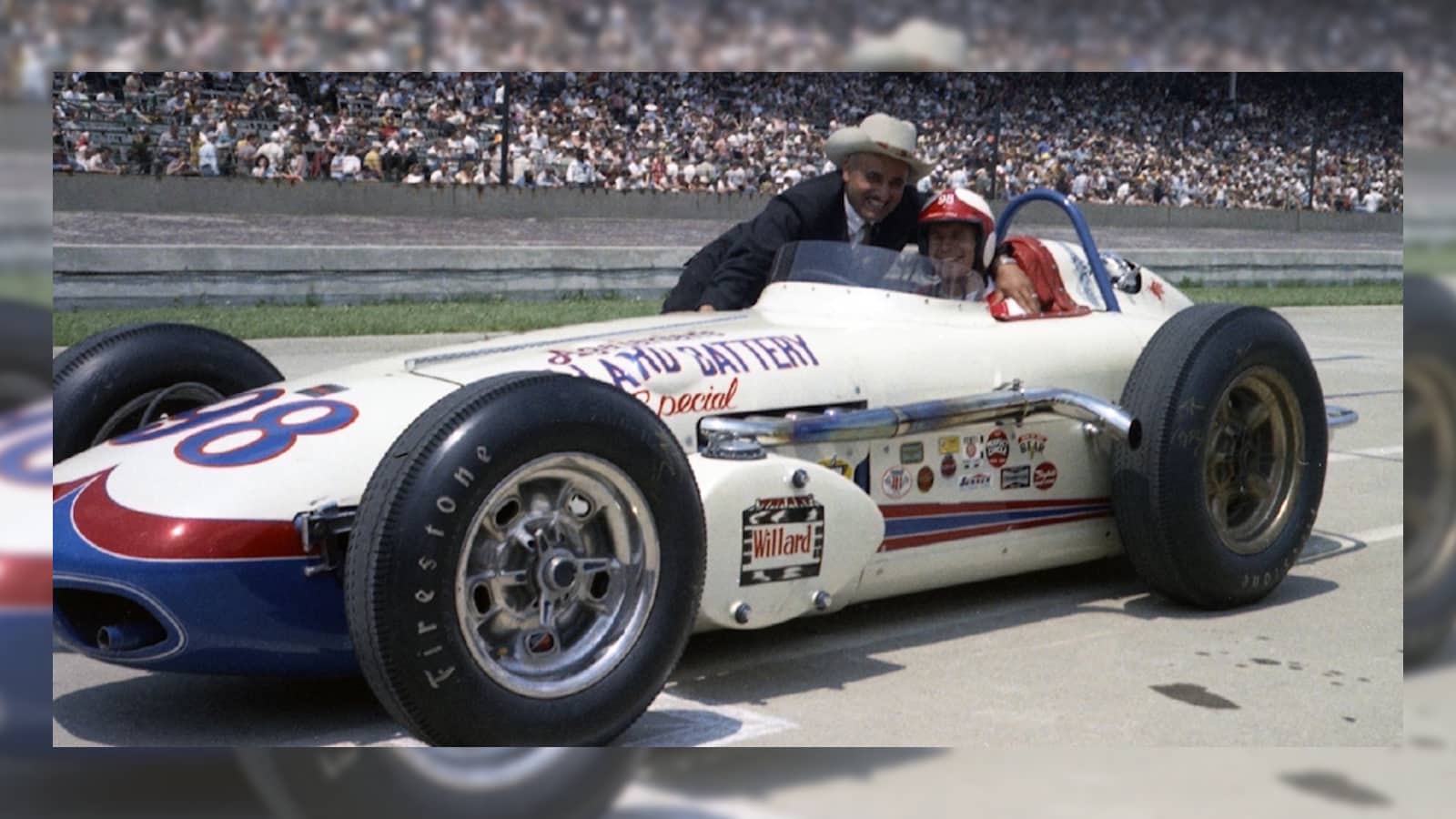
Shaffer gives an almost granular look at each contest, from the intro providing an overview of the ’61 race and Brabham’s debut. That introduction leads to the obvious details of the machinery and the equally obvious profiles of the drivers, along with side glances at owners, sponsors and the track. In 1962 Parnelli Jones would be the first to qualify at over 150 miles per hour in his Watson-Offy roadster, while taking the overall win a year later.
For this reader, the most compelling chapters deal with the arrival of Jim Clark and his Lotus in ’63 and his dominance in ’64, only to retire with his Dunlop tires shedding tread. Those two years of getting familiar with Indy and its demands led to his overall win in ’65 for both the Lotus team and rear-engined, Ford-powered formula. But as you’d hope, there’s more.
Shaffer’s exhaustive coverage gives us the stark – almost violent – contrasts between the drivers of the late ‘50s and early ‘60s, with their dirt oval backgrounds and good boys/bad boys demeanor, and the Euro invasion of the ‘60s, which brought with it those British accents and almost gentrified demeanor. And in contrast to the sameness of today’s Indycars, giving the annual contest but one chassis and only two powertrains, there was an absolute overdose of chassis designs to pique your curiosity, far more than those remembering just the Indy roadster and Lotus.
Notable variants of established designs were provided by Mickey Thompson (natch), Smokey Yunick (natch) and Frank Kurtis. Of those variants the most successful would be Andy Granatelli’s turbine-powered STP Oil Treatment Special. With just four laps to go in 1967 it broke, sending Parnelli Jones to the pits and propelling AJ Foyt to his third win in just seven Indy races.
Finally, if you tire of the big news in this decade of racing, there’s also the minutiae. Dan Gurney – if you didn’t know – was the first to wear a full-coverage Bell Star helmet, while driver Jim Rathmann was the last Indy winner to wear an open helmet made of pressed cardboard(!) and leather.
And beyond the news big and small, Shaffer provides us with info on the many fatalities that plagued the decade. The good news, of course, is that oval racing is a much safer sport today. But that doesn’t diminish the real loss – and lingering loss – racing took in what is often regarded as its heyday.
Rick Shaffer’s It’s…A…New Track Record! is published by Evro Publishing, distributed in North America by Quarto Publishing Group, and is widely available from U.S. retailers. (If going online, Autobooks/Aerobooks in Burbank is worth a try…) It’s priced at $95 American, which is invariably subject to change between now and 2028. The cost of consumer goods remains tariffying…