





Car Reviews
LEXUS TX500h AWD – A HYBRID FINDS ITS RHYTHM

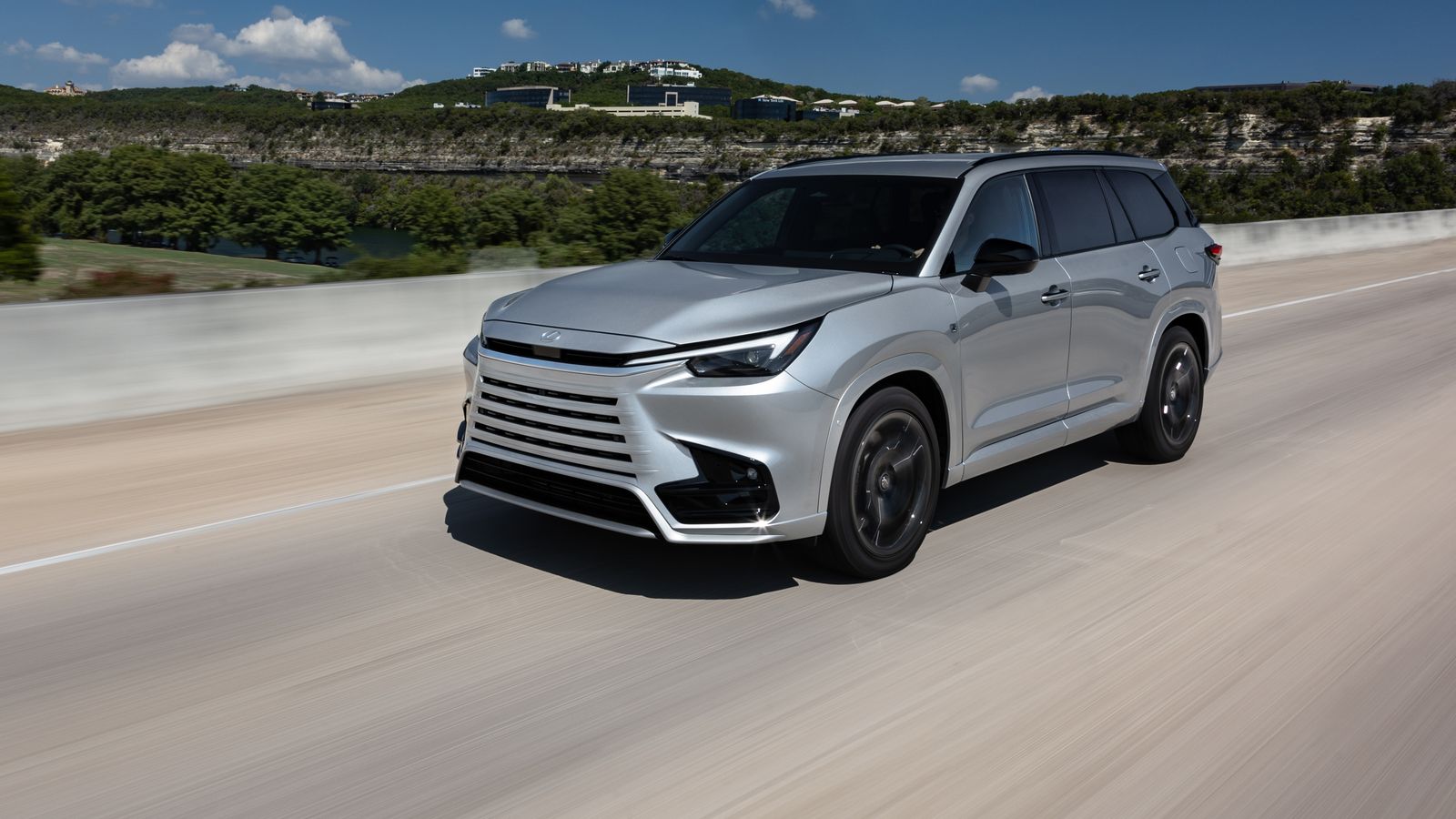
LEXUS TX500h AWD
A HYBRID FINDS ITS RHYTHM
OKOLONA, Ark. — Judging by Arkansas 51, the highway engineers played a practical joke on its designer: someone hid the straightedge. Although the two-lane blacktop crosses the mostly flat Terre Noire Natural Area and Prairie Ridge Preserve, without a mountain in sight, it twists like a Bavarian roadway climbing into the clouds.
It was here that I fell in love with the 2026 Lexus TX 500h AWD. Longer, wider, and half a ton heavier than a standard RX, or its cousin the Toyota Highlander, the hefty six-seater is balanced, sure-footed, and nimble — an elephant in a tutu.
Built in Princeton, Indiana, the TX is the first Lexus SUV assembled in the United States and rolls down the same line as the Toyota Grand Highlander.
Priced in the $60,000 to $80,000 range, the TX takes on European stalwarts such as the Audi Q7, Mercedes-Benz GLE and GLS, and BMW X5 by offering similar luxury, more space, better fuel economy, and, thanks to Lexus’ DIRECT4 all-wheel drive, competitive handling — all for around ten grand less. The penurious seeking a premium SUV that can handle itself will find the package hard to resist.
Introduction
Now in its third production year, the TX is Lexus’ newest three-row SUV, aimed at families who want space, comfort, and predictable ownership costs. It sits above the RX and below the LX, and the 500h trim adds a turbo-hybrid powertrain and performance-oriented AWD. Prices run from the high $50s for the base TX 350h to the low $80s for the plug-in TX 550h+. The 500h models fall in the low-to-mid $70s.
Chief competitors: strengths and weaknesses
Before comparing the TX to its European rivals, it helps to note one key fact: every Lexus TX is a hybrid. The lineup includes the TX 350h, the performance-oriented TX 500h, and the TX 550h+, a plug-in hybrid with extended electric-only range.
This stands in contrast to Audi, BMW, and Mercedes, which still rely primarily on turbocharged six- and eight-cylinder engines. The TX’s hybrid-only strategy shapes its value proposition in ways that matter over years of ownership.
- Audi Q7 — Strengths: sharp handling, rich interior. Weaknesses: tight third row, lower fuel economy.
- BMW X5 — Strengths: strong engines, athletic feel. Weaknesses: expensive options, higher ownership costs.
- Mercedes-Benz GLE/GLS — Strengths: quiet ride, upscale cabin. Weaknesses: pricing climbs fast, less efficient.
- Volvo XC90 — Strengths: safety tech, clean design. Weaknesses: aging platform, modest towing.
Hybrid durability, residual value and long-term costs
The TX’s strongest advantage comes from Toyota’s long record with hybrid systems. Multiple fleet studies — including taxi operators in Vancouver, New York, and Los Angeles — show Toyota/Lexus hybrids routinely running well past 300,000 miles with original battery packs. Regenerative braking reduces wear, electric assistance lowers engine strain, and hybrid cooling systems operate at lower average temperatures. These factors produce lower lifetime maintenance costs than comparable non-hybrid powertrains.
Fuel savings compound over years of ownership. A TX 500h averaging 27 mpg versus a BMW X5 at ~23 mpg or an Audi Q7 at ~20 mpg saves up to 200 gallons every year. All of these vehicles, by the way, want premium unleaded — selling for $4.25 a gallon the week I test-drove the TX. Over a decade, that becomes more than $8,500 — a real difference for families who keep vehicles long-term.
Another factor tilts the value equation even further: higher residual values. Toyota and Lexus hybrids hold more of their original investment better than almost any competing powertrain. Auction data, fleet-retirement records, and used-market tracking all show the same pattern. When a hybrid system runs past 300,000 miles with minimal degradation, buyers trust it.
That trust shows up in resale prices. A TX 500h will almost certainly retain more of its original value than a Q7, X5, or GLE, especially once those European models age into their higher-maintenance years. Lower fuel costs, lower repair costs, and higher resale value form a three-part advantage that compounds over time.
Exterior design
The TX follows Lexus’ current design language, which favors clean surfaces and a more restrained front fascia. The spindle grille has softened into a broad, integrated shape. The body stretches to 203.5 inches, making it longer than the RX and slightly longer than the Highlander. The wide stance and long wheelbase give it a planted look.
Aerodynamics matter on a vehicle this size, and Lexus shapes the roofline and rear pillars to reduce drag. The TX also uses active grille shutters to improve efficiency at highway speeds. Competitors like the Q7 and X5 lean toward sportier profiles, while the XC90 keeps a boxy Scandinavian look. The TX lands in the middle: not flashy, not plain, but coherent.
Functional design shows up in the large doors, low step-in height, and wide cargo opening. Lexus also improves visibility with thin A-pillars and large mirrors. These choices help drivers who spend time in tight parking lots or on rural roads.


Performance and driving experience
The TX 500h uses a 2.4-liter turbocharged four-cylinder paired with electric motors for a combined 366 horsepower. DIRECT4 AWD constantly shifts torque between axles. On Arkansas 51, the system kept the SUV composed through tight bends. The steering is direct, and body roll stays controlled.
Acceleration is adequately brisk for merging and passing. It will not match the BMW X5’s straight-line punch, but it feels confident. Ride quality is smooth on rough pavement, and the suspension absorbs dips without drama. The TX is not an off-roader, but AWD and ground clearance handle gravel roads and wet grass.
Historic reliability favors Lexus. The RX hybrid systems have long track records, and the TX uses updated versions of those components. European rivals offer more powerful engines, but their long-term maintenance costs tend to be higher.
Edmunds notes that the TX is “easy to drive despite its size” (https://www.edmunds.com). Car and Driver calls it “surprisingly composed in corners” (https://www.caranddriver.com). These comments match my experience on Arkansas 51.

Interior design, comfort, and technology
The cabin layout is simple and functional. Controls sit where you expect them. Materials feel solid and build quality is tight. The TX seats six with captain’s chairs in the second row. The third row fits adults, which is rare in this class. Cargo space reaches 97 cubic feet with seats folded.
Competitors vary: the Q7’s interior feels more premium, the X5’s is more driver-focused, and the XC90’s is more minimalist. The TX wins on space and ease of use.
Technology shapes the cabin’s ambience. The 14-inch touchscreen runs Lexus’ latest software, which responds quickly and supports wireless Apple CarPlay and Android Auto. Voice controls work well for navigation and climate settings. The digital gauge cluster is clear, and the optional head-up display adds useful information.
Motor Trend writes that the TX’s cabin tech is “straightforward and modern” (https://www.motortrend.com). Kelley Blue Book adds that the TX offers “a calm, quiet interior that suits long drives” (https://www.kbb.com).
Driver-assistance features include adaptive cruise control, lane-keeping assist, blind-spot monitoring, rear cross-traffic alert, and automatic emergency braking. The systems behave predictably and avoid abrupt corrections.


Safety features
Standard safety equipment covers the basics: forward collision warning, pedestrian detection, lane-departure alert, and adaptive cruise control. Optional features include a surround-view camera, parking sensors, and automated parking.
Crash-test ratings for the 2026 TX are not yet available. The Toyota Grand Highlander, which shares the TNGA-K platform, earned strong marks from IIHS and NHTSA, so I assume the TX will perform similarly once tested.
Pricing and value
Trim levels include the TX 350h, TX 500h, and TX 550h+. The 500h Premium offers the best balance of features and price. Options include upgraded audio, larger wheels, and advanced driver-assistance packages.
The TX’s value stands out. It costs less than the Q7, X5, and GLE when similarly equipped. It offers more space and better fuel economy. Weaknesses include modest towing capacity and less dramatic interior styling.
Bottom line
The 2026 Lexus TX 500h AWD meets the needs of families who want room, comfort, and predictable ownership costs. It handles well for its size, rides smoothly, and carries people and cargo without strain. Competitors offer sharper performance or richer interiors, but they cost more and burn more fuel.
Drivers who want a practical, comfortable, and efficient three-row SUV will find the TX 500h a strong choice. It fits the long, winding stretches of Arkansas 51 and the daily demands of suburban life. It is a vehicle built for people who, like an elephant dancing Swan Lake, value balance, clarity, and calm.