



Car Reviews
Excellence Without a Recruiting Letter: Mazda’s CX‑90 PHEV Earns Everything the Hard Way

Excellence Without a Recruiting Letter
Mazda’s CX‑90 PHEV Earns Everything the Hard Way
I am a D=RT man. Distance equals rate times time. It’s the first equation I reach for behind the wheel — not obsessively, but reflexively, the way a pilot scans the horizon. I know how far I will go, how long it will take, and what the fuel situation should look like. It makes me an annoying co‑pilot and – not incidentally – a useful automotive journalist.
Which is why the drive to Scrapper Stadium stayed with me.
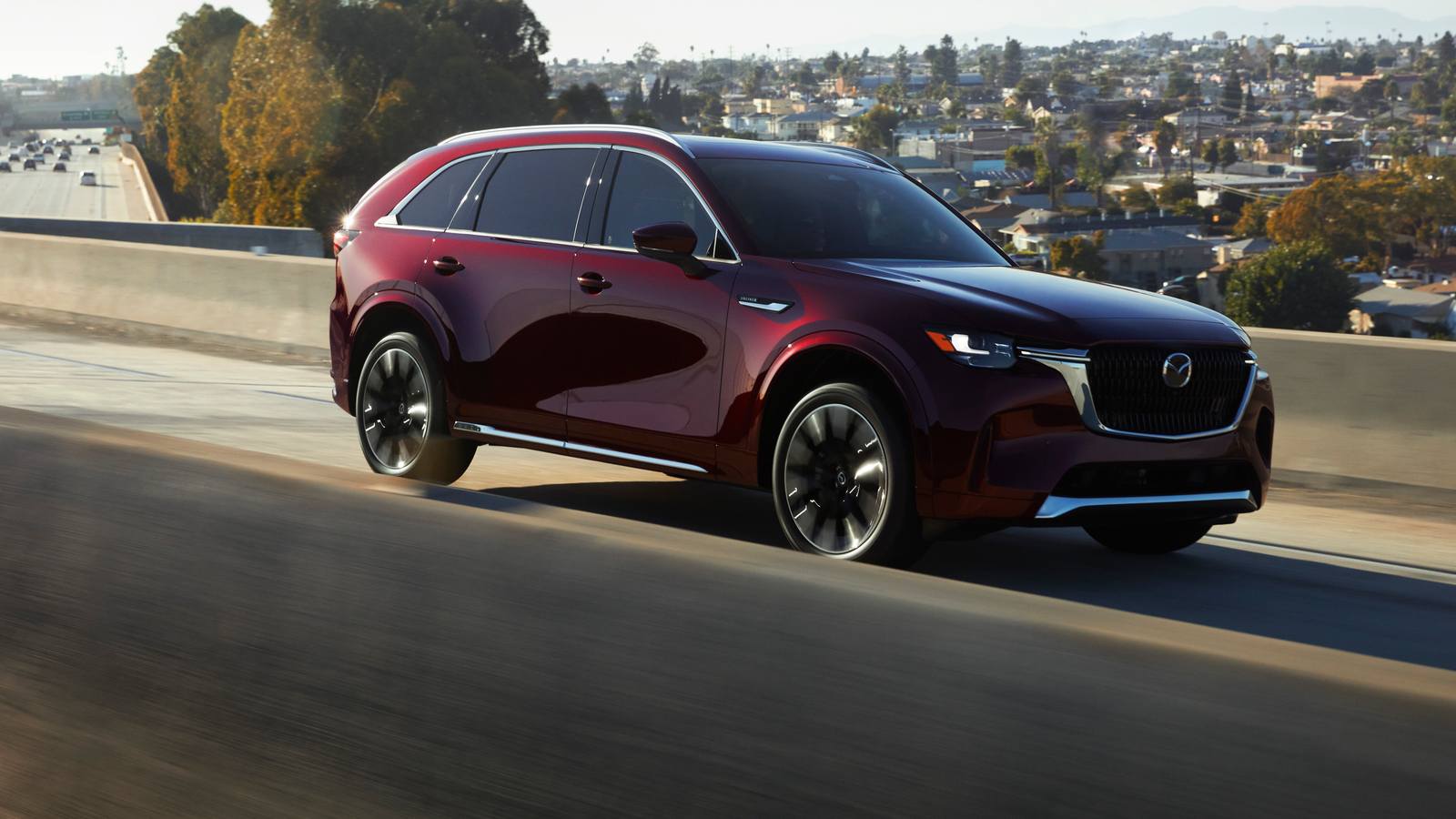
The night before, I plugged the Mazda CX‑90 PHEV into the same outlet that runs the box fan in my garage — 120 volts, one extension cord, about a quarter’s worth of electricity. By morning, the 26-mile EV range was full. I left in EV mode, ran silently through the first stretch, then somewhere north of Fulton toggled Charge Mode — a button that turns the inline-six into a rolling generator, feeding the 17.8‑kWh pack while cruising.
A pattern quickly appeared: twenty miles on the engine, fifteen on the battery. I pulled into the stadium lot showing 35.4 mpg on a 5,200‑pound, three‑row SUV. Think about that, Tahoe drivers.
In the end, the most important ratio for those who own plug-in hybrids is the one between the number of miles driven in an average day on pure electricity, and those driven with the gas engine engaged. My lovely bride, for example, rarely exceeds the 26-30 miles she gets from electricity. She plugs in every night. So far this year, I filled her car with gas exactly one time. She averages better than 200 mpg.
I sat there a moment longer than necessary.
Nashville, Ark., doesn’t need outside validation. The town is well kept because people care about it. The football program reflects the same character: eight state titles, 36 conference crowns, and a quarter-century record of 240–72. The formula is simple: big ole country boys throwing haymakers up front, while fast and lithe skill players perform ballet in space. No Scrapper has ever gone on to play at a higher level. The machinery of recognition runs on different inputs than the machinery of winning.
The CX‑90 PHEV belongs in that same category. It does not appear on enough shopping lists. The parallel is exact.
Bold move, half finished
Credit where it’s due: Charge Mode is audacious. No other factory-produced PHEV gives the driver a dedicated, user-selectable mode that forces the gas engine to actively recharge the high-voltage traction battery while the vehicle is in motion. Most plug‑in hybrids recover energy only through regenerative braking or a wall outlet. Mazda built a DC-to-DC converter that turns the engine into a rolling generator — a real engineering commitment.
The 30-and-15 rhythm isn’t a hack. It’s the car used exactly as designed, just more deliberately than most owners bother.
But every DIY video on the DC-to-DC connection — common these days for cat campers with lithium-iron battery packs — carries the same warning: fuse both ends. Input side needs a 30–60-amp slow-blow fuse; output side needs a 10–20-amp fuse protecting the 12-volt system. The guide is explicit: never wire directly. The system runs at lethal voltage.
Which raises the deeper question: why is any of this the driver’s problem? The CX‑90 already knows its battery state, speed, load, and remaining distance. A modest application of the computing power already aboard — the same brain that suggests playlists and parallel‑parks — could cycle Charge Mode automatically and optimally. No button. No arithmetic. No human intervention.
The concept is inspired. The execution leaves the hardest part to the driver.

Let’s be honest
This next part is on me.
The drive home from Nashville was late. Charge Mode did not seem to be working, but I was tired and in no mood to pull over and recycle the system. Pulling into my cul-de-sac around midnight, the CX‑90 was running on battery — total silence. After 58 years of driving, my nervous system equates engine sound with engine status — off or on. A PHEV in EV mode at midnight satisfies neither half of that equation.
I had notebooks, a tablet, a camera, a phone — the full archaeology of a road test to excavate. I may not have pushed the big button. Better than fifty-fifty odds I caused what happened next.
The following morning, I pressed start to show my wife the car. A large warning filled the cluster: Get me to a dealer. The batteries are dead. The engine fired once, briefly, and died. I never heard it again.
The vehicle had almost certainly sat in Ready mode all night, draining the 12-volt battery with no engine to replenish it. Once the 12-volt weakened, the DC-to-DC converter lost its footing, the high‑voltage management module followed, and both batteries reached zero. Mazda has documented this exact cascade in four service bulletins.
My grandson reacted appropriately to the tow truck. “They’re stealing Grampa’s car!” The dealer recharged both batteries and likely updated the Body Control Module software. The car ran perfectly as it headed off to Dallas.
But here is the honest comparison: I’ve owned Toyota hybrids for twelve years. If I forget to turn one off, the Toyota eventually handles it. It monitors an unattended Ready state and shuts itself down. Mazda could have bought the cheapest Corolla on the lot and reverse-engineered that feature.
This is a PHEV-specific issue — not a problem with the CX‑90’s inline‑six models, which remain excellent, efficient, and far less expensive. Mazda’s ICE technology is superb. The PHEV software suite lacks two features it should have had from day one:
- An auto‑shutoff for silent EV situations
- Automated Charge Mode cycling
Electrification is a paradigm Mazda entered late. The hardware is strong. The software is still catching up.
Similarly, Mazda chose an 8‑speed gearbox instead of Toyota’s ultra-smooth and reliable planetary-gear CV transmission. I noted clunky shifts and wondered if a press‑fleet vehicle with nearly 10,000 miles may have been abused. It happens.
Alas, a run through the forums and published works turned up other complaints from customers — including 1st-to-2nd-gear grunts Mazda classifies as ‘operating as designed,’ shift‑timing failures that shut the vehicle down, and low‑speed shudder or stalling tied to hybrid-system faults.
The lineup, the math
- CX‑90 3.3 Turbo (mild hybrid) MSRP: ~$39,000–$45,000 EPA: 24 mpg combined (RWD), 23 mpg (AWD)
- CX‑90 3.3 Turbo S (mild hybrid) MSRP: ~$53,000–$61,000 EPA: 23 mpg combined (AWD)
- CX‑90 PHEV (the only full hybrid) MSRP: ~$50,000–$57,000 EPA: 26 mpg / 56 MPGe / 26 EV miles
Mazda’s non-PHEV models are excellent machines: smooth inline-six power, credible efficiency, and none of the PHEV’s battery‑management quirks. They are honest choices for buyers who want fuel economy without electrification complexity.
The PHEV is a different proposition — brilliant in concept, unfinished in software.
How it stacks up
| Vehicle | starting msrp | towing | cargo (3rd row up) | fuel economy |
|---|---|---|---|---|
| Mazda CX‑90 PHEV | $50,495 | 3,500 lbs. | 15.9 cu ft | 26 mpg / 56 MPGe |
| Toyota Grand Highlander Hybrid | $43,755 | 5,000 lbs. | 20.6 cu ft | 34–36 mpg |
| Honda Pilot | $42,195 | 5,000 lbs. | 18.6 cu ft | 21 mpg |
| Kia Telluride Hybrid | $46,490 | 4,500 lbs. | 21.3 cu ft | 31–35 mpg |
| Hyundai Palisade Hybrid | $44,160 | 4,000 lbs. | 19.1 cu ft | 29–34 mpg |
| Acura MDX (SH‑AWD) | $55,450 | 5,000 lbs. | 18.1 cu ft | 21 mpg |
Here is the unvarnished truth:
The CX‑90 PHEV is not competitive with the Grand Highlander Hybrid unless the dealer puts real money on the table.
Toyota’s hybrid architecture is in its fourth decade, and it is hands-down the most reliable system on the road, with resale values to match. Mazda’s is in its first. The difference shows up in towing, cargo, efficiency, and software maturity.
Bottom line
The Scrappers will win their conference again and perhaps another state title. Haymakers up front, ballet in space. No scholarship letters coming. Eight state titles and a town that knows what it has built.
The CX‑90 PHEV wins on efficiency, driving character, and an interior that competes honestly with luxury badges. It loses on towing and cargo. Its two missing software features are not engineering impossibilities — just decisions Mazda has not yet made.
The concept is not flawed. It is simply unfinished.
If your life doesn’t require a boat trailer, if you have an outlet in the garage, and if you want a three‑row vehicle that still knows the difference between a haymaker and a ballet — the Scrapper scholarship is sitting right there on the table.
Just make sure you push that button on the way out.