




Car Reviews
Toyota’s Corolla FX – FUN, FUNCTIONAL…AND FUELISH

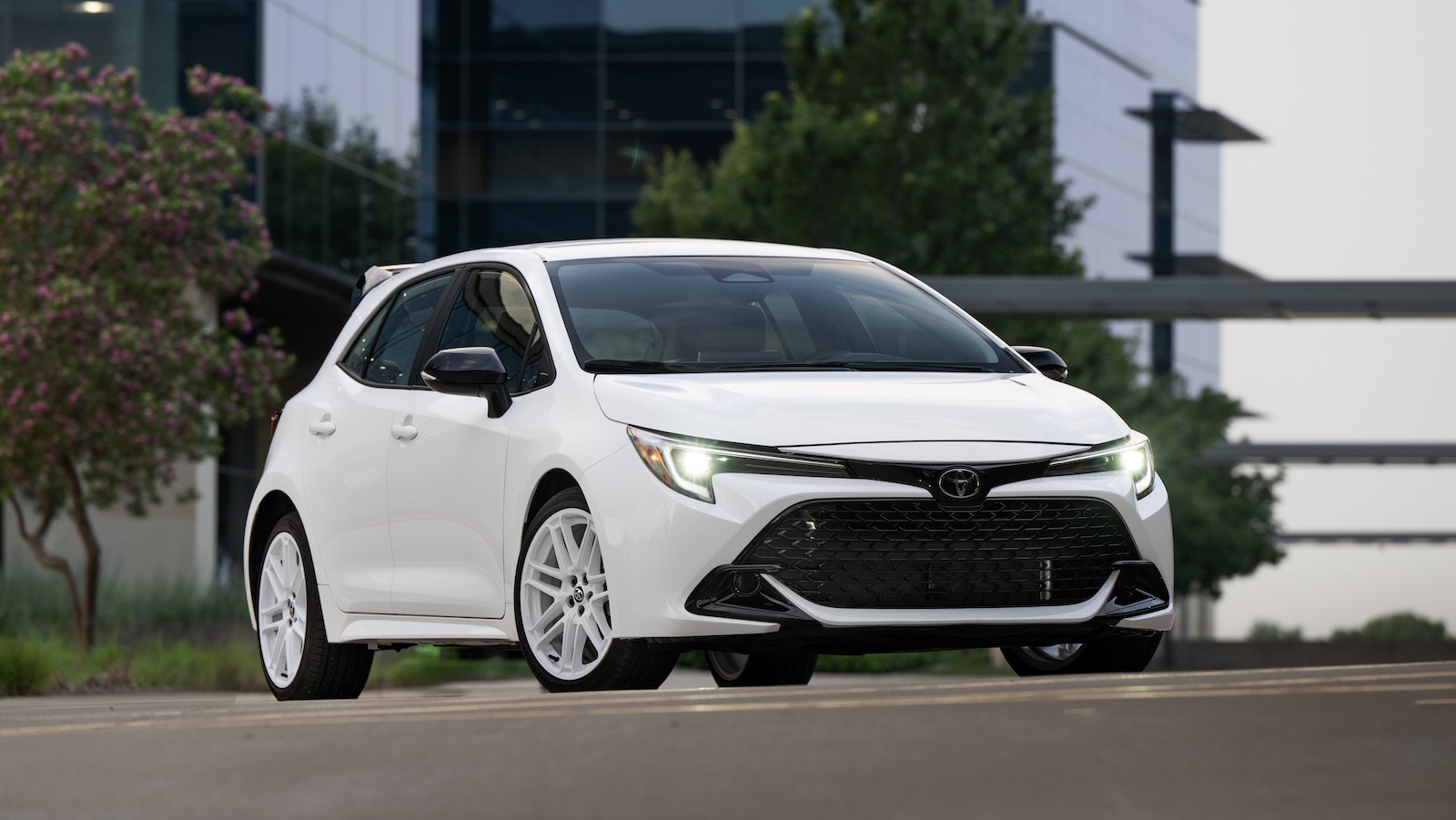
Toyota’s Corolla FX
FUN, FUNCTIONAL…AND FUELISH
If – of late – you’ve found yourself at the gas pump, your jaw hanging open as you try to make sense of what is happening in the Strait of Hormuz, take heart: the Trump administration just made hybrids make even more sense.
That thought came to me while filling up a 2026 Toyota Corolla FX, a cute, taut little hatchback that is a joy on the highway and nimble around town, but (sadly) doesn’t come in a hybrid variant. Starting around $27,000 and delivering about 33 mpg, the FX is one of the more frugal rides on the road.
But if it’s a hatchback you desire, Toyota’s Prius LE hybrid costs only about $1,200 more and delivers nearly twice the fuel economy.
At today’s average fuel price, the math is not complicated. Drive 15,000 miles a year, and the FX will burn roughly 455 gallons; the Prius, about 263. At $3.62 a gallon, that’s a difference of $700 a year. Which means the Prius makes up its price premium in under two years. After that, every mile is cheaper.
Fuel isn’t the only place hybrids save. Regenerative braking stretches the life of pads and rotors. Electric motors take strain off engines, which tend to last longer when they aren’t doing all the work themselves. Hybrids also run cooler, start smoother, and spend less time idling at high RPM.
None of this shows up on a window sticker, but does show up in the long run, especially for drivers who keep their cars past the warranty, like me. My camping-mobile is a 20-year-old Highlander that still gets 28 mpg, does not burn a drop of oil, has never needed a brake job, and has never required a penny for maintaining electric components.
If (and this is a big if) the drive battery ever needs replacing, a company in Dallas does the work in a couple of hours for around $1,500. If I ever must replace the V6 gas engine, I will junk the car instead.


Same name, different bones
Toyota sells three Corolla models, but they don’t all sit on the same bones. The sedan rides on the standard TNGA-C platform, the hatchback on the short-wheelbase variant, and the Cross on the taller, SUV-tuned version.
They’re cousins more than siblings, which explains why the hatchback feels so taut and why the Cross feels so upright and useful. It also explains why Toyota can’t simply drop the hybrid system into the FX, much as I wish they would.
What struck me first about the FX is how alive it feels. The short wheelbase gives it a crisp, eager turn-in that makes the car feel lighter than it is, and the steering—quick, predictable, and pleasantly weighted—invites you to place the car exactly where you want it.
It’s not a sports car, but it has that rare small-car honesty: you point, it goes.
Around town, the FX darts through gaps with the kind of nimbleness that used to define compact hatchbacks, the steering wheel alive in your hands. Then they got heavy and clumsy. On the highway, the Corolla hatch settles into a confident, composed stride that belies its size.
The 2.0-liter engine won’t win any drag races, but its response is peppy and immediate, especially in the midrange where most daily driving happens. Toyota’s infotainment system is above average for the class—clean menus, quick responses, and a screen that doesn’t wash out in sunlight.
And the company’s driver-assist suite remains one of the best tuned in the business: lane-centering that doesn’t ping-pong, adaptive cruise that behaves like a patient human, and collision-avoidance tech that stays out of the way until you need it.
The FX recalls a long-standing refrain about Toyota’s small cars – light on their feet, honest in their responses, more fun than the spec sheet suggests.
It’s the kind of car that reminds you why small hatchbacks still matter: they are inevitably efficient, practical, and quietly joyful.
Consider the Cross
If you lean more toward a small SUV, the Corolla Cross is one of the smartest plays on the market. It rides on the same TNGA-C bones but stretches them upward into a package that feels upright, useful, and unpretentious. The Cross offers the visibility people want, the cargo space they need, and – crucially – the option of Toyota’s excellent hybrid system.
The hybrid version starts around $29,000 and returns 42 mpg combined, making it one of the most economical crossovers on the road. Drive those same 15,000 miles a year, and the Cross Hybrid burns about 357 gallons — 100 fewer than the FX — saving $360 annually at today’s prices. It’s not as playful as the FX, but it’s the smarter long-term play: more space, better mileage, and the durability advantages that come with Toyota’s hybrid system.
Where the FX feels playful, the Cross feels purposeful. It’s not flashy, but it’s sensible in the way good tools are sensible: it does the job, every day, without complaint.
Bottom line
Which brings me to the uncomfortable truth of the moment. As much as I enjoyed the FX – and I did – I can’t in good faith recommend any vehicle that doesn’t include a form of electrification. Hybrids run cooler, last longer, and burn less gas. And as noted, they stretch brake life, ease engine wear, and make the economics of ownership kinder over time.
In a world where fuel prices can swing on a headline and durability is the new luxury, electrification isn’t a political statement. It simply makes sense.