

Car Reviews
Improving Toyota’s RAV4: CLIMB EVERY MOUNTAIN

Improving Toyota’s RAV4:
CLIMB EVERY MOUNTAIN
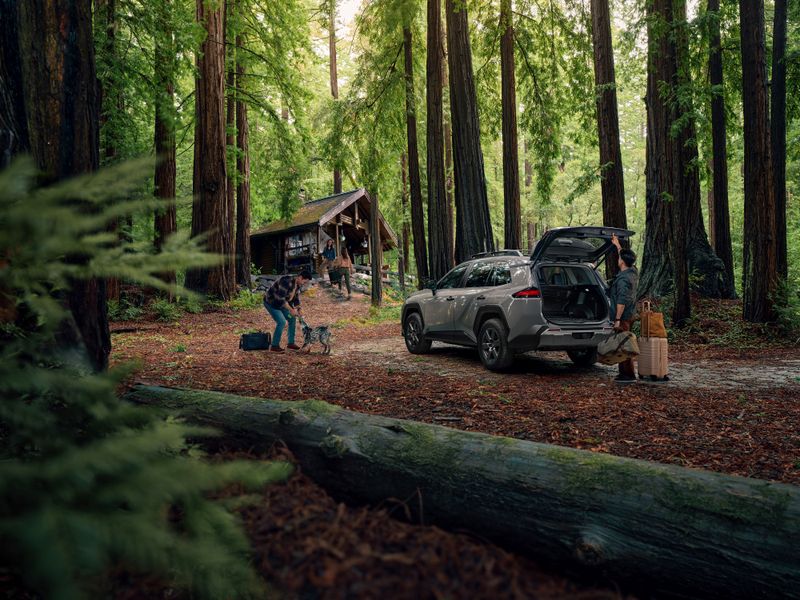
Toyota’s next-generation hybrid system is somewhere on the horizon, but the company isn’t saying much. That silence has set the automotive press fluttering, guessing about what’s coming and – of course – how soon. I don’t bother trying to outguess Toyota. Instead, after a week in the 2026 RAV4 Woodland plug-in hybrid, I’m left wondering how they plan to improve on a vehicle that already feels like a mature, confident step forward.
Let’s be clear about the timeline: We tested the 2026 model. Toyota’s vague announcement said changes will be seen in late 2027, perhaps as 2028 models. It is hard to say.
The RAV4 PHEV has grown into itself. It’s quicker than anyone expects, smoother than any earlier RAV4, and efficient enough to make you rethink what a compact SUV can be. It’s also the clearest sign yet that Toyota’s long game in electrification is starting to pay off.
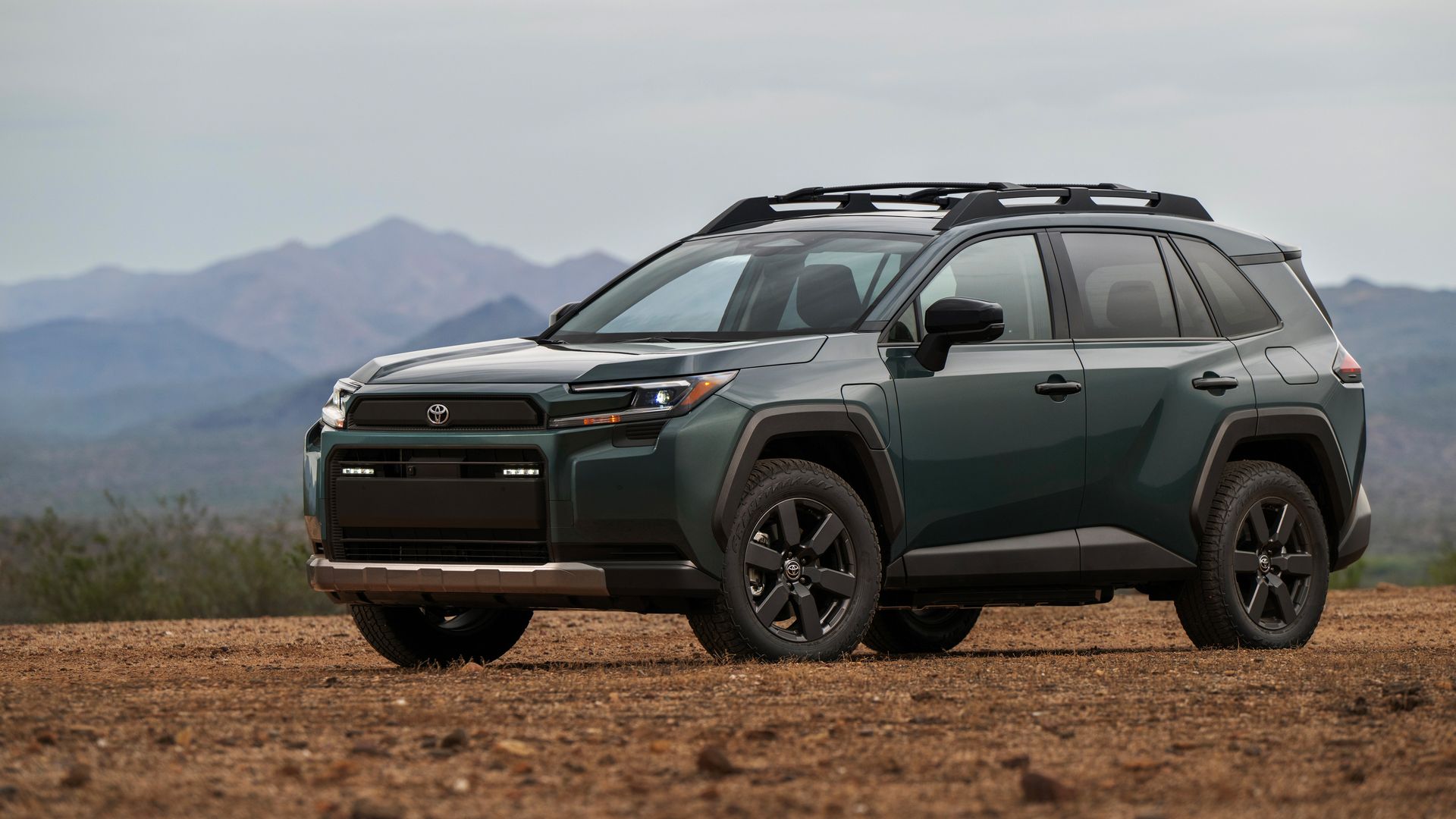
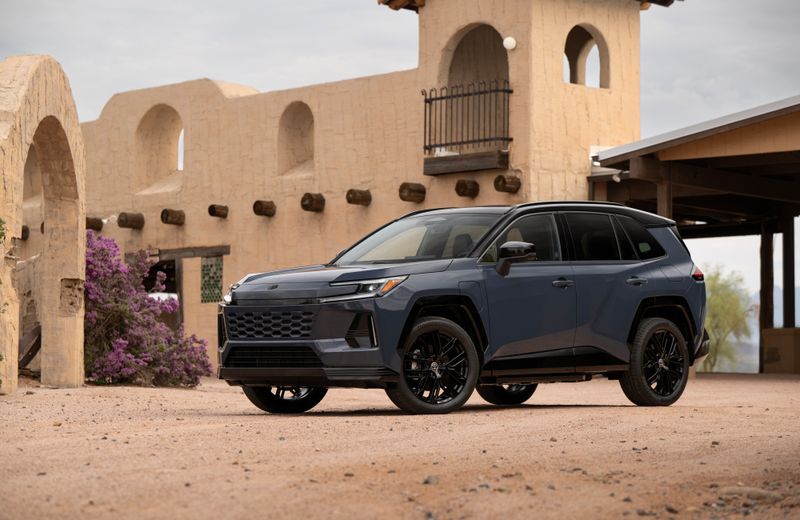
Sleek, muscular
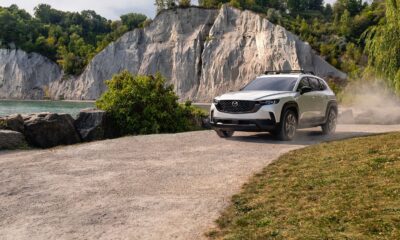
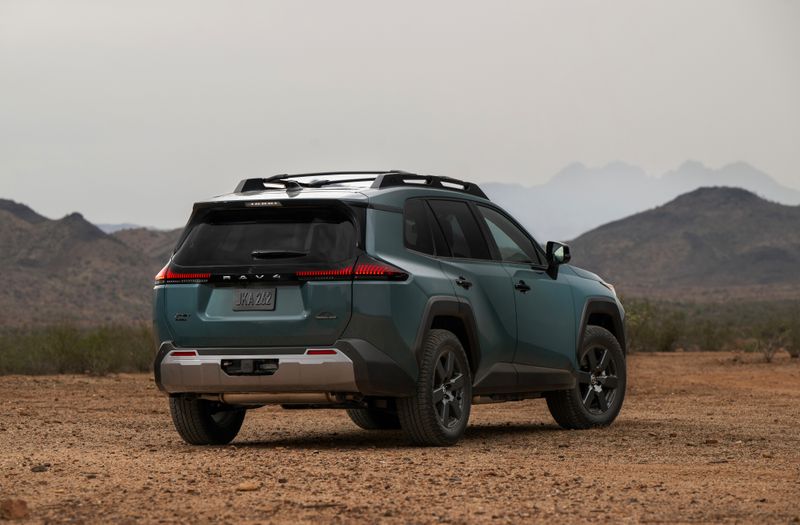
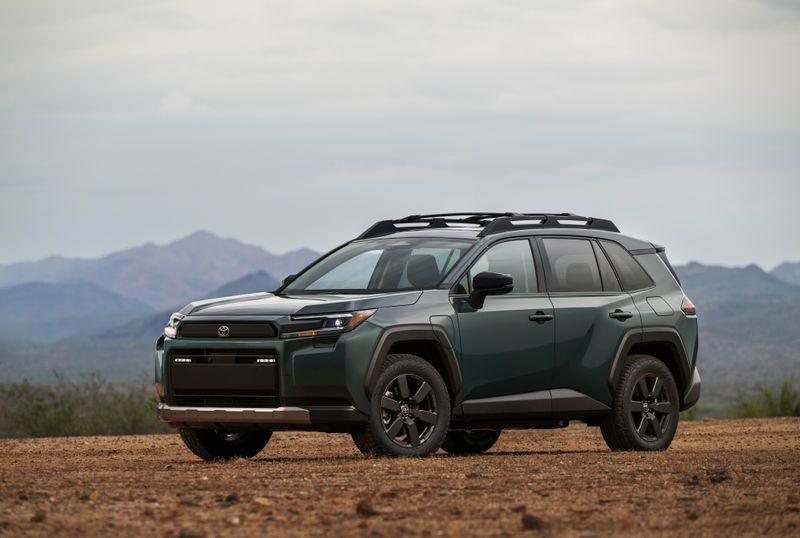
The Woodland PHEV looks like a RAV4 that spent a summer in the mountains. It carries Toyota’s familiar angular design language, with squared wheel arches, a tall stance, and a front fascia that signals capability more than flash. From the driver’s viewpoint, a muscular and sculpted hood adds a sense of strength and control, the kind of visual cue that makes the vehicle feel planted even before you start moving. The Woodland trim adds dark accents, roof rails, and the cargo basket that sits high enough to catch wind like a sail. The dimensions match the standard RAV4, and the aero design is respectable until you bolt a metal basket on top.
Compared to competitors, the RAV4 Woodland PHEV looks more rugged than the Tucson or Sportage, more assertive than Ford’s now-discontinued Escape, and more modern than the Forester. It expresses Toyota’s design language clearly: functional, upright, and ready for weather.
Fastest family hauler on planet
The Woodland PHEV surprised me. The powertrain delivers strong acceleration — 302 combined horsepower makes this the second-fastest vehicle in Toyota’s current lineup (behind only the GR Corolla), sprinting from zero to 60 in a brisk 5.5 seconds — enough to make highway merges feel easy and to make stoplight launches genuinely fun.
The electric motor handles low-speed work smoothly, and the gas engine steps in without drama. The ride quality is the biggest change from earlier RAV4s. The old choppiness is gone. The suspension now feels composed, even on broken pavement.
In city driving, the electric range covers most daily trips. On the highway, the hybrid system settles into a quiet rhythm. Off road, the Woodland trim gives confidence on gravel and dirt, though this is not a rock crawler. The all-wheel-drive system is smart and predictable.
Edmunds notes that the RAV4 Prime “delivers strong acceleration and real-world efficiency,” a line that applies here as well.
Clever, well crafted cabin
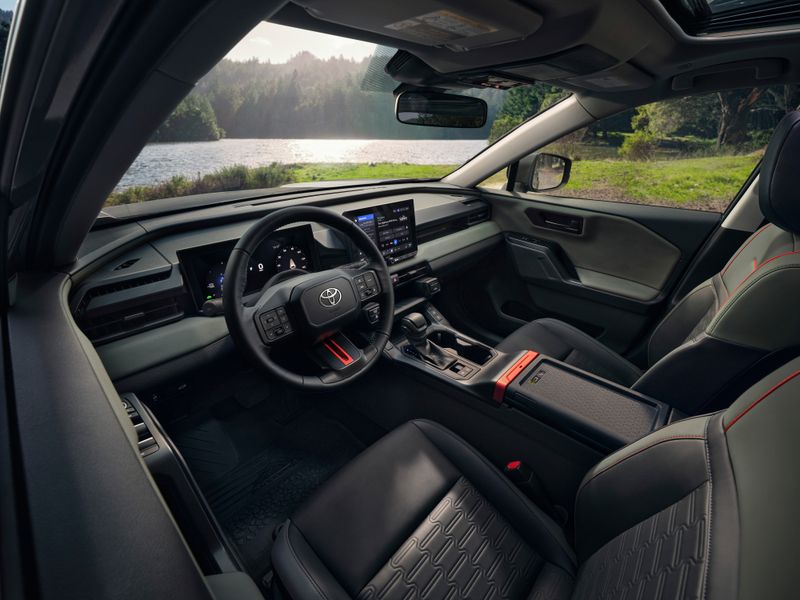
Inside, the Woodland PHEV feels more refined than its rugged exterior suggests. The cabin layout is simple and easy to understand. Materials are solid and build quality is tight. The seats are comfortable for long drives, and the rear seat offers good space for adults. Cargo room is generous, though the plug-in battery does intrude on underfloor space; the PHEV sacrifices about a cubic foot or two of total capacity compared to the standard hybrid. It’s a trade-off most owners accept for the electric range. Toyota also knocked it out of the park when designing nooks, crannies, and cubbyholes, creating more storage space than a fisherman’s vest on opening day.
The ambiance comes from quiet operation, smooth transitions between power sources, and a cabin that filters out road noise well. The moonroof adds light, though the roof basket creates wind noise at speed. Even with the moonroof fully closed, the basket whips up enough venturi to require closing the headliner fully — a small but noticeable concession to aerodynamics that regular highway drivers will want to remember. Roof racks only look cool.
Car and Driver’s take on the RAV4 interior is blunt but fair: “It’s practical, but not fancy.”
Adds Motor Trend: “Toyota’s infotainment is finally easy to use.”
Pricing and Value
The Woodland AWD PHEV sits near the top of the RAV4 price range. The broader lineup runs from the low $30,000s for base models to the mid $40,000s for most of Toyota’s hybrids and PHEVs. My test vehicle cost $49,130, including the moonroof and the roof basket. The NACS adapter adds future-proofing for charging. KBB sums up the RAV4’s value well: “It remains one of the most sensible choices in the segment.”
Looking Ahead
Owning the Escape PHEV and driving this Woodland has taught me something simple that many buyers still miss: plug-in hybrids only shine when you actually plug them in. Your phone has the same quirk. Our Escape averages more than 200 mpg because we treat it like an EV with a backup engine, not a gas car with a bigger battery. Toyota seems to understand this pattern.
But the real question — the one that has the industry buzzing — is what battery technology will power the next generation. And here, the silence from Toyota is almost deafening.
The company has confirmed that next-generation lithium-ion batteries for hybrids will arrive starting in 2027, with production capacity in Japan being retooled to supply roughly 600,000 new vehicles. The strategy is three-pronged: a “Popularization” battery based on bipolar lithium-iron-phosphate chemistry that cuts cost by 40 percent while adding 20 percent more range; a “Performance” battery promising over 800 kilometers of range; and a “High Performance” version, combining bipolar architecture with a high-nickel cathode, due between 2027 and 2028.
Toyota has not confirmed which of those architectures — if any — will land in the RAV4. That vacuum has been filled with speculation. Some reviewers believe Toyota will adopt a blade-type architecture like BYD’s. Others insist the company is ready to deploy solid-state batteries. No one who knows is saying — yet.
The blade hypothesis has the most tangible data behind it. BYD’s second-generation blade battery, a lithium-iron-phosphate chemistry famously validated by the nail penetration test — puncture a cell with a steel nail and it simply refuses to ignite, a thermal-stability party trick that conventional nickel-manganese-cobalt packs cannot replicate — has pushed energy density from 140 Wh/kg in the first generation to 190–210 Wh/kg. That is a roughly 35 to 50 percent jump in gravimetric energy density. Volumetrically, the blade achieves nearly 50 percent more capacity in the same space than its predecessor.
Toyota’s own bipolar LFP battery, by contrast, is projected to deliver a 20 percent range increase, though the company has not disclosed specific energy density figures. Moving from Toyota’s current combined anode/cathode design to a blade-style architecture would represent a leap of perhaps 30 to 50 percent at the cell level, depending on which generation serves as the benchmark. But those are extrapolations. The actual details of the battery changes stay hidden.
The wild card remains solid state. Toyota holds more than 1,600 solid-state battery patents globally — more than any automaker — yet the technology has proven stubbornly elusive. The company has pushed back its mass-production timeline repeatedly, most recently in July 2026, when the promised 2026 target was moved to 2028. Toyota and Idemitsu are collaborating on sulfide solid electrolyte production, aiming for introduction in 2027 or 2028, though analysts note that past timelines have a habit of slipping.
If Toyota adopts a blade-style LFP pack for the next RAV4 PHEV, the electric range could climb from today’s 40-plus miles to something closer to 70 or even 100, while keeping more than 500 miles of gas in reserve. That would turn a PHEV from a transitional technology into a daily EV for almost everyone, without asking drivers to rely on public charging networks. If solid-state arrives instead, the gains could be more dramatic still — though that is still an extremely big if.
And then there is the quieter question, the one that touches owners more directly than any chemistry chart: will the new battery architecture reclaim the cargo space lost to the current pack? The PHEV currently sacrifices about a cubic foot (or two) of underfloor capacity when compared to the standard hybrid. A blade design’s slender, cell-to-pack construction could theoretically pack more kilowatt-hours into a thinner footprint, restoring that lost space without sacrificing range. Or Toyota may choose to keep the exterior dimensions unchanged and simply stuff in more cells, prioritizing maximum electric miles over maximum trunk volume.
That decision, like so much else, stays locked behind Toyota’s closed doors, a practice not uncommon for publicly traded companies.
Bottom Line
After a week with the 2026 Toyota RAV4 Woodland AWD Plug-In Hybrid I’m convinced Toyota knows exactly what it’s doing. The vehicle feels mature, capable, and efficient. It delivers robust performance, quiet operation, and real electric range. The interior is comfortable and practical. The technology works without fuss. The safety features are complete and easy to trust.
This is a compact SUV for people who want reliability, efficiency, and all-weather traction. It fits families, commuters, and outdoor-leaning drivers. It also fits buyers who want a plug-in hybrid without giving up the familiar feel of a gas-powered SUV.
If Toyota plans to improve on this platform, I’m curious to see how. For now, the Woodland PHEV feels like a sweet spot: a compact SUV that does almost everything well and asks extraordinarily little in return. Whatever battery chemistry ends up under the next generation, and whether that pack gives us back our cargo space or simply gives us more miles, the bar has been set high.