







Book Review
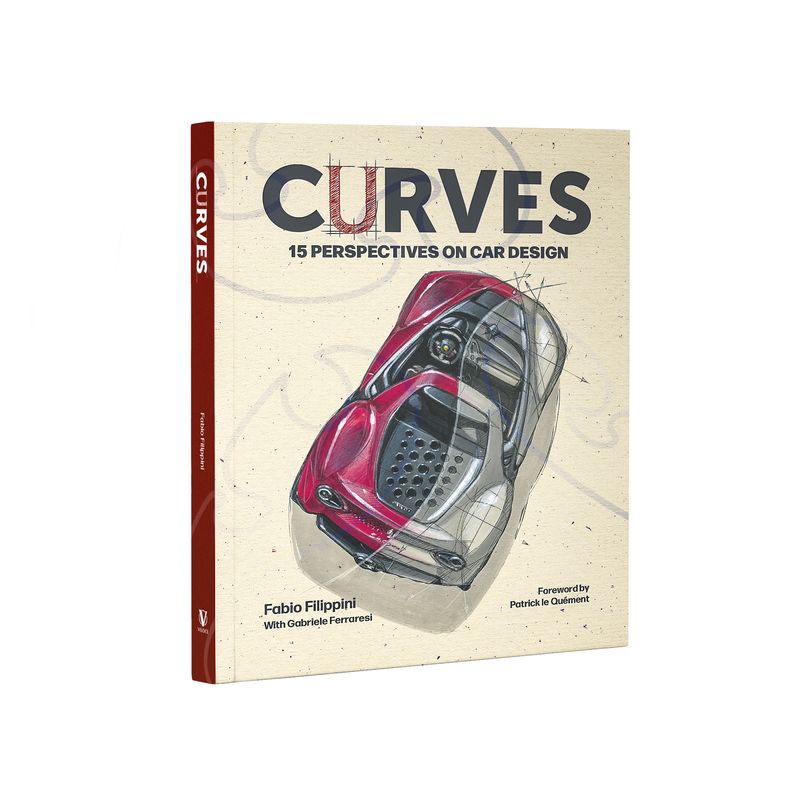
BOOK REVIEW: CURVES: 15 PERSPECTIVES ON CAR DESIGN

BOOK REVIEW: CURVES
15 PERSPECTIVES ON CAR DESIGN
As a committed car enthusiast, I’ll admit it: There are more than a few things working against you in pursuit of that enthusiasm. The most obvious is balancing the want with the need, and then (of course) is your ability to satisfy those wants; over the years it’s been occasionally tough to satisfy the needs. (A self-destructing Grand Cherokee – in its defense, it was 20 years old – would be a recent example.) That enthusiasm, however, is inevitably rooted in a car’s design. A comprehensive dissection of automotive design is offered by Fabio Filippini in his book, CURVES – 15 PERSPECTIVES ON CAR DESIGN. I see it as a must read, deftly combining – in this season of giving! – both want and need.
There would be few more qualified authors to tackle the topic. Schooled at the Scuola d’Arte Applicata e Design in Torino and receiving a Master’s degree in Architecture and Industrial Design at Politecnico di Milano, Filippini began his career at an independent design studio working on commissions from Mitsubishi, SEAT and Scania. That was followed – in 1989 – by his move to Japan, giving him a chance to work for both Japanese and European car manufacturers. And that – as you might surmise – was just the beginning; Filippini would accumulate both experience and air miles from a wide array of international entities.
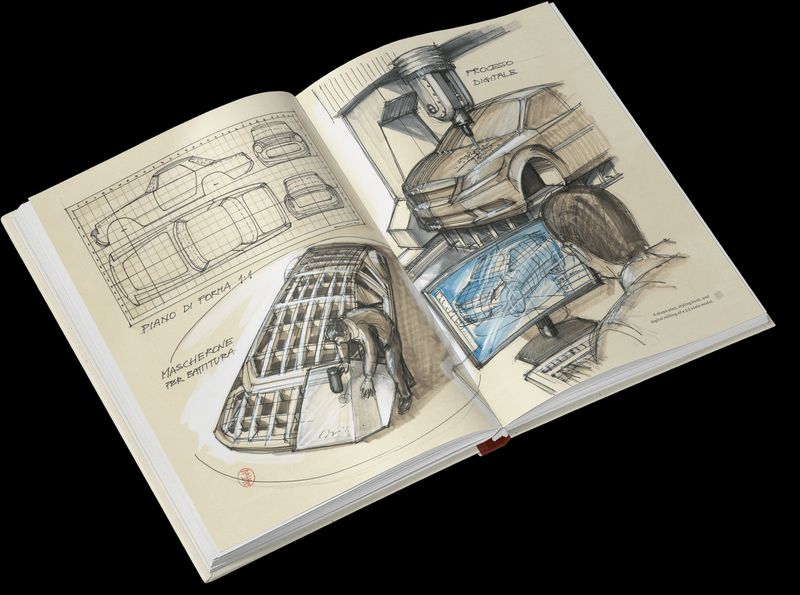
The premise of CURVES – 15 PERSPECTIVE ON CAR DESIGN is to walk you through, via both an involving text and Filippini’s seductive artwork, the rationale – and irrational – premise of the automobile and its design. And while, when initially picking it up, I assumed I’d find 15 chapters devoted to a specific car or marque, I instead found a wide-ranging discussion (and accompanying illustrations) of the author’s editorial viewpoint.
Chapter One – Dreaming of Cars – separates car design from other industrial disciplines, reminding us that while the automobile has a wide-ranging societal impact, the same can’t be said for the washing machine. We may appreciate clean clothing, but you won’t find a Concours celebrating the washing machine, nor a museum devoted to it. And Filippini’s verbiage is supported by an amazing collection of his illustrations, underscoring the automobile’s cultural impact with everything from the Goldfinger Aston to the Italian Job’s Mini and the Love Bug’s Beetle.
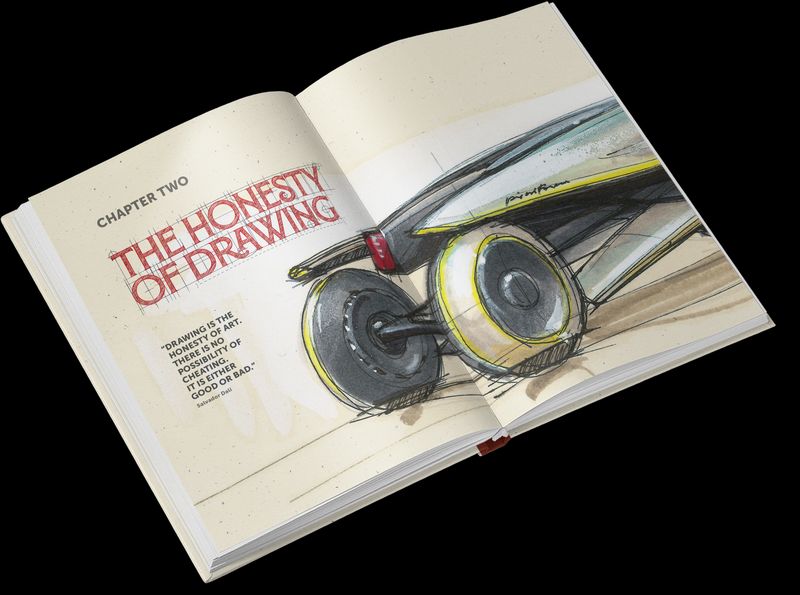
In the book’s second chapter the author underscores the honesty of drawing, which opens with a quote attributed to artist Salvador Dali: “Drawing is the honesty of art. There is no possibility of cheating. It is either good or bad.” We learn that in the design process, if questions arise the answer can inevitably be found when going back to the drawing. And that begs my question: In looking at a less-than-graceful design, how is it the design team didn’t go back?
In Chapter Eight – The Rhythm of Forms – Filippini emphasizes both the importance of proportion and, at the same time, dispatching the almost infinite number of details one by one. And again, the text is amplified by an absolutely wondrous number of illustrations, illustrating shapes similar – or dissimilar – from Renault, Volkswagen and Mercedes.
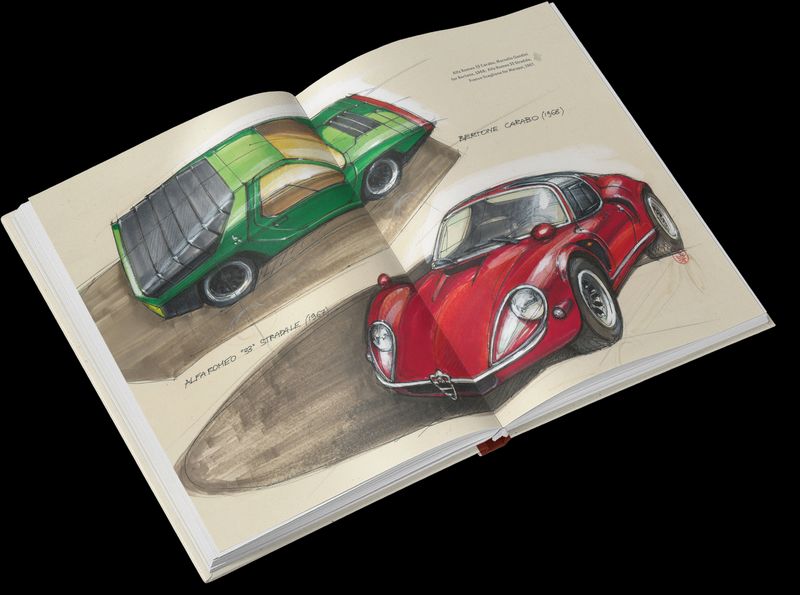
The text of CURVES is engaging, while the illustrations are completely captivating. Filippini’s automotive journey began with his father gifting his then 8-year old Fabio a 1/43rd-scale model of Pininfarina’s Ferrari 512S Modulo concept, lavishly illustrated on page 17. And while automotive illustrations are depicted throughout the book’s 240 pages, those that most resonated for me were the representations in Chapter Six, featuring the E-Type, Dino 246 GT, Porsche 911 S and Ferrari’s GTO II. Given a few million$ from an IPO and I’d have all four, but then, for only $30 I can have Filippini’s book!
That book – CURVES – 15 PERSPECTIVES ON CAR DESIGN – is published by Veloce. It is available from your local bookseller, or veloce.vo.uk. The review copy was provided to me by Veloce…and yep, I’m keeping it!