

Car Reviews
2026 Toyota Camry Hybrid – FULL DISCLOSURE: IT COMES WITH COMPOSURE

2026 Toyota Camry Hybrid
FULL DISCLOSURE:
IT COMES WITH COMPOSURE
LANGLEY, Ark. — It is tempting, easy, and ultimately wrong to dismiss the 2026 Toyota Camry Hybrid as boring. America’s best-selling sedan, the Camry is rock-solid, fuel-efficient, quiet, strong, and — in the case of the all-wheel-drive hybrid version — genuinely entertaining to drive.
On a road trip to a Friday night football game, the Camry did exactly what I expected of a modern car, with zero surprises. Everything sat where I expected it. The seating felt comfortable. The sound system remained pleasant. Wind and road noise stayed low. And Toyota’s driver-assist system kept the trip relaxed and safe.
Then came the mountain curves near the Albert Pike Recreation Area.
Shooting through those twists, the two-motor Camry gripped the pavement like a banker clutching his last dollar during an audit — absolutely unwilling to let go.
The AWD that thinks ahead
Toyota’s hybrid all-wheel-drive system isn’t mechanical — it’s predictive. The front axle uses the engine and primary motor, while a separate electric motor sits on the rear axle, waiting to deliver instant torque. With no driveshaft or clutch pack to engage, the system pre-loads the rear wheels the moment sensors detect rain, clay, or the slightest twitch of steering angle. Grip arrives before trouble does.
Toyota calls it AWD i, and that ‘i’ matters. There is no driveshaft running to the rear. Instead, the front axle is powered by Toyota’s 2.5-liter four-cylinder engine and the primary electric motor. On the rear axle sits a torquey dedicated electric motor, all controlled by a module that runs dozens of samples per second.
The rear motor can deliver roughly 1,000 to 1,200 pound-feet of wheel torque at zero rpm, which settles the car before instability can form.
A base Camry starts at $29,600. AWD adds around $1,500 — a small price for added security on wet and slippery roads. It is also reasonably quick if you drive as I do… which you absolutely should not.
The competition
- Honda Accord Hybrid: Strong acceleration, roomy rear seat, polished ride; higher pricing at upper trims.
- Hyundai Sonata Hybrid: Sleek design, generous tech, competitive fuel economy; firmer ride, louder cabin.
- Kia K5 Hybrid (where available): Bold styling, strong value; smaller dealer network, lower resale.
The Nissan Altima should be on this list but is not, because Nissan does not offer a hybrid Altima.
Familiar shape, sharper details
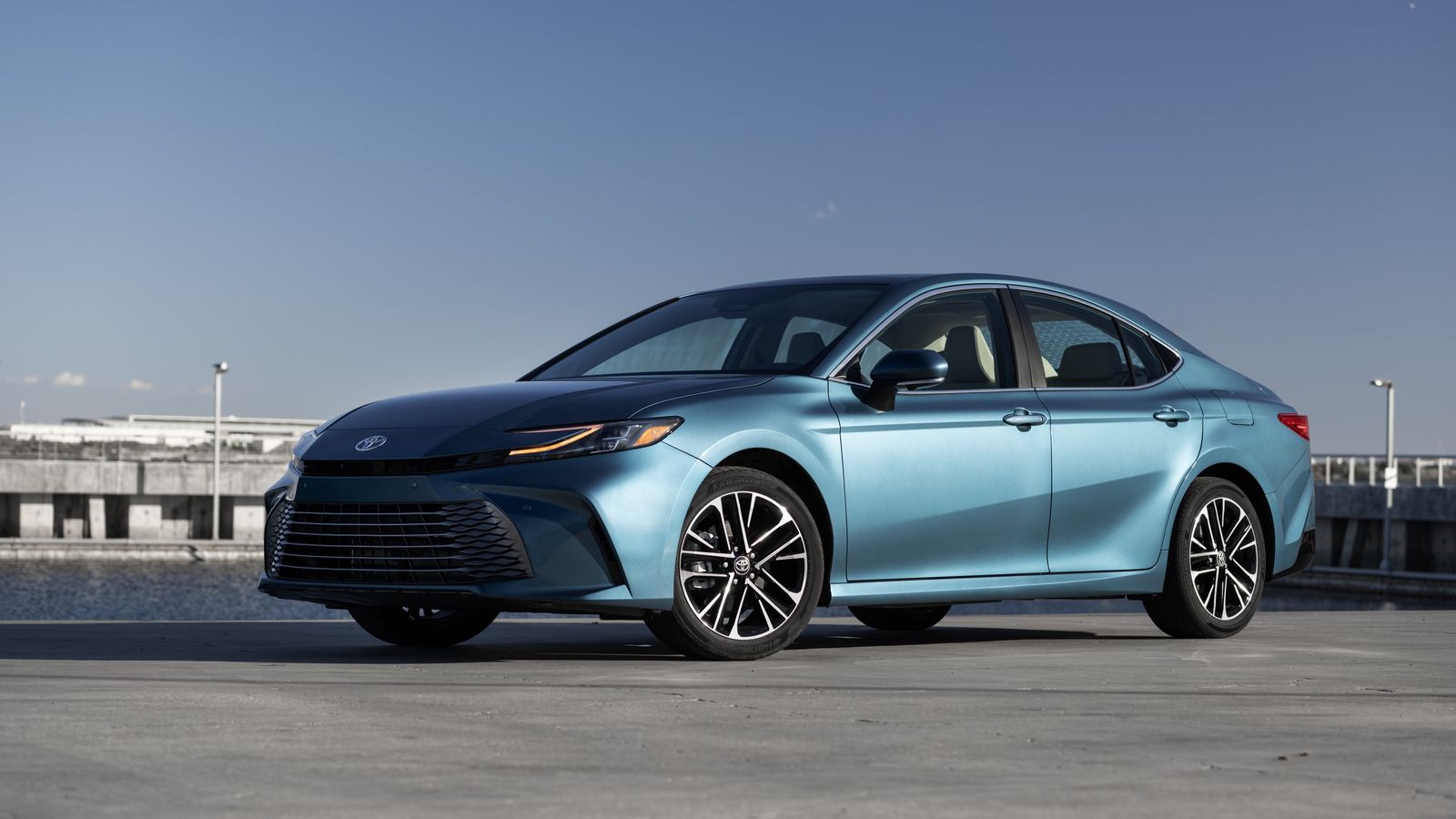
The 2026 Camry Hybrid carries the ninth-generation redesign that arrived for 2025. The body keeps the familiar three-box sedan shape, but the nose and tail show sharper lines, a wider stance, and more confident lighting signatures. Motor Trend calls the styling “handsome,” while noting that the roofline cuts into headroom.
The Camry stretches just over 192 inches in length, atop a wheelbase of 111 inches, matching the Accord and Sonata almost inch for inch. That footprint yields stable highway manners and enough cabin space for adults in both rows. Aerodynamics favor efficiency; Toyota shapes the front fascia, mirrors, and rear deck to reduce drag and wind noise. Edmunds reports nearly 46 m.p.g. in testing.
Functional design shows up in small ways. The hood line and fender shapes give a clear view of the corners. The mirrors sit on the doors rather than the A-pillars, which reduces blind spots. Air curtains around the front wheels manage airflow and turbulence.


Calm, with a hidden edge
Every 2026 Camry uses a hybrid powertrain. Output lands in the 220-to-230-horsepower range, depending on trim and drive layout. Edmunds notes that an XSE front-drive Camry reaches 60 m.p.h. in 7.8 seconds, slightly quicker than the Sonata Hybrid and close to the Accord Hybrid.
In daily driving, the hybrid system feels buttery smooth. The electric motor handles low-speed work and fills torque gaps, while the engine steps in without drama. Under hard throttle, the engine note grows coarse — a common trait in hybrids.
Handling depends on trim. The LE and XLE tune the suspension for comfort. The SE and XSE tighten things up, with firmer damping and more direct steering. Motor Trend writes that the Camry Hybrid is “fun to drive” and praises the reworked suspension and braking system.
My experience in the SE Hybrid with AWD i matches that consensus. The predictive rear motor adds confidence that front-drive rivals cannot match.
Toyota’s hybrid drivetrains have a long reliability record. The Prius, earlier Camry Hybrids, and RAV4 Hybrids show strong durability in fleet and taxi use. My own 2007 Highlander Hybrid passed 300,000 miles with routine maintenance, which reinforces Toyota’s reputation for hybrid longevity. The 2026 system builds on that history with updated control software and refined packaging.

Cabin: straightforward, with real substance
Inside, the Camry Hybrid aims for clarity rather than drama. The dashboard centers a large touchscreen, with physical controls for climate and key functions. Materials vary by trim: the LE uses more hard plastics, while the SE, XLE, and XSE add soft-touch surfaces, contrast stitching, and nicer door panels.
Seating comfort draws mixed reactions. Edmunds praises the roomy rear seat and quiet ride but wishes for more supportive front cushions. In my SE Hybrid, the seats felt fine for a football-game road trip, with enough bolstering to hold me in place through curves. Space works well for four adults; five fit for shorter trips. Trunk volume sits in the mid-teens cubic feet range, competitive with the Accord and Sonata.
Technology shapes the ambience. A large central screen — up to 12.3 inches on higher trims — anchors the cabin. Wireless Apple CarPlay and Android Auto come standard, along with wireless phone charging on many trims. Toyota’s latest infotainment software responds quickly and uses clear menus. Voice controls handle navigation and basic functions.
Driver-assistance tech plays a major role. Toyota Safety Sense 3.0 includes adaptive cruise control, lane-keeping assist, lane-departure warning, automatic emergency braking, and pedestrian detection. Optional features add a surround-view camera, front and rear parking sensors, and Traffic Jam Assist. Edmunds calls Toyota’s suite “nearly flawless” in everyday use.
Crash-test ratings for the current Camry generation remain strong. Historically, the Camry earns five stars from the National Highway Traffic Safety Administration and Top Safety Pick+ honors from the Insurance Institute for Highway Safety. Early data for the redesigned model suggests similar performance.
The 2026 Toyota Camry Hybrid does not chase drama. It delivers calm behavior, strong safety tech, and real fuel savings. Reviewers across outlets land in the same place. Motor Trend sums it up as “excellent fuel economy” and “fun to drive.” Kelley Blue Book echoes that consensus with its focus on value and reliability.


Who this car fits
- Commuters who want low fuel costs and strong safety tech.
- Families who need a quiet, roomy sedan.
- Drivers negotiating mixed weather.
- Long-term owners who care about reliability and resale.
A midsize sedan that stays steady on a wet Ouachita night, carries me to Friday football without drama and delivers nearly 600 miles of range on a full tank earns its place at the top of the list.